Most lists of home side hustles are written by people who have never done any of them. They pad the count to thirty, include things that are businesses rather than side work, and never mention what anything pays per hour.
This is the shorter, more useful version: what these actually earn, how long until money arrives, and which ones are not worth the evening. For an immediate deadline rather than a monthly build, what actually reaches $500 quickly is the relevant page.
The honest comparison
| Side hustle | Realistic hourly | First payment | Startup cost |
|---|---|---|---|
| Freelance service using an existing skill | $25 – $80 | 2 – 4 weeks | $0 |
| Paid task and campaign work | $10 – $30 | 1 – 7 days | $0 |
| UGC content for brands | $30 – $90 | 2 – 6 weeks | $0 – 50 |
| User testing websites and apps | $15 – $60 | 1 – 2 weeks | $0 |
| Tutoring or teaching | $20 – $50 | 2 – 4 weeks | $0 |
| Transcription and captioning | $12 – $25 | 1 – 3 weeks | $0 |
| Reselling secondhand items | $10 – $40 | 1 – 3 weeks | Stock cost |
| Print-on-demand designs | $2 – $15 | 2 – 6 months | $0 – 30 |
| Affiliate content | $0 – wide | 3 – 9 months | Hosting |
| Paid surveys | $1 – $4 | 2 – 6 weeks | $0 |
Two columns matter more than the hourly rate when you are choosing.
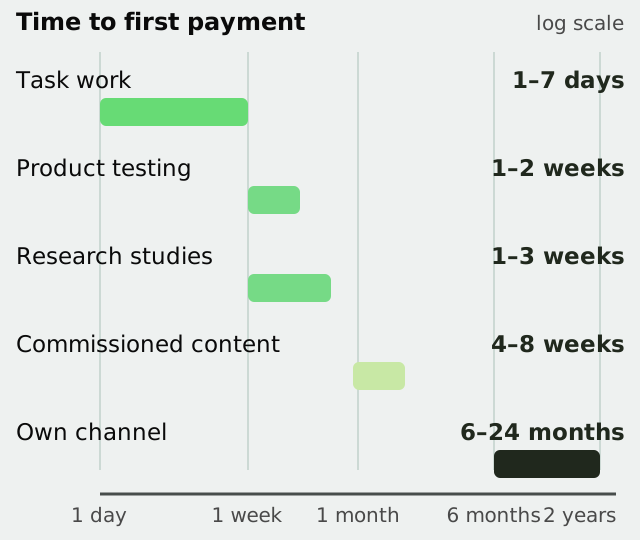
First payment decides whether you stick with it. Anything that pays nothing for six months requires belief you probably do not have yet, and most people quit in month two of a nine-month plan.
Startup cost decides your downside. A side hustle that needs $300 of stock is a small business with inventory risk, which is a fine thing to start and a different decision from picking up paid work at the weekend.
What pays best, and why
Freelance services on a skill you already have
If you are still deciding where to start rather than comparing options, the three questions that narrow it is the quicker route in. If you have not chosen a route yet, the four constraints that narrow it is the step before this one.
Highest rate on the list, and it is not close. If you can write, design, edit video, build spreadsheets, bookkeep, translate, or administrate, someone pays for that by the hour and the rate starts around $25.
The barrier is not skill. It is that you have to find the client, which means outreach that feels uncomfortable. Virtual assistant work is the most common shape this takes, because almost any administrative or coordination job contains several sellable services. That discomfort is the entire reason the rate stays high, because most people take the $12 option to avoid it.
Start with people who already know you can do the thing. Former colleagues, small businesses you use, anyone who has watched you work. One retained client at five hours a month covers most of what any of the lower-paid options on this list produce in total. If the constraint is when you are free rather than what you can do, evening work and weekend work split the options differently.
Paid task and campaign work
Businesses pay individuals to complete small, specific, verifiable jobs — testing a signup flow, filming a short clip, checking how a page renders in a particular country, giving structured feedback on a product. Each takes minutes to an hour, and payment follows approval rather than a monthly cycle.
This is the fastest route from nothing to a first payment, and a marketplace where the work is funded before you start needs no portfolio, no clients and no upfront money from you. The trade is that it does not compound. You are paid for the task and the next one starts from zero.
It works best as the thing that produces money this week while a higher-rate skill develops behind it.
The one thing to check before committing to any platform: is the work funded before you start it? A campaign with money held up front means the buyer cannot vanish after you deliver. Unfunded means you carry that risk for a $15 job, which is a bad trade at any rate.
UGC content for brands
Filming short videos that companies post on their own channels. No audience needed, because the brand is buying the file rather than your following.
Rates run well above general task work, and the ceiling is high — experienced creators bill $150 to $500 per clip once usage rights are priced properly. The catch is a four-to-eight-week ramp while you build something to show. The seven-day starting plan covers what to film and where to send it.
Worth starting if you can tolerate a month before the first payment. Not worth starting if you need money in ten days.
User testing
Recording yourself using a website or app and speaking your thoughts aloud. Sessions run fifteen to thirty minutes and pay $10 to $60 depending on whether they are unmoderated or a live interview with a researcher.
Genuinely good hourly rate, genuinely limited supply. Most people report a handful of sessions a month rather than a steady stream, so treat it as a supplement rather than a plan.
What is not worth your evening
Paid surveys. The advertised rate ignores screen-outs, which are unpaid and common. You answer six qualifying questions, get told you do not fit, and that time is gone. Real effective rates sit between $1 and $4 an hour. Use them on time you could not otherwise sell, and never as a strategy.
"Get paid to watch videos" apps. Some are legitimate and pay real money. Almost all pay cents per hour, and the ones advertising serious income are usually selling something else. There is a real version of this — paid feedback and testing work — and it is not the same as passively leaving a video playing.
Anything requiring you to recruit others. If earnings depend on people you sign up rather than work you do, that is the structure of a pyramid scheme regardless of what the product is.
Courses that teach you a side hustle. The reliable money in most of these is made selling the course. Every method genuinely worth doing is documented free by people who do it.
Print-on-demand and passive-income products, initially. Not scams, and some people do well. The timeline is months and the failure rate is high, which makes it a poor first choice for someone who needs the money to feel real.
Choosing one
Answer two questions honestly and the choice usually makes itself.
How soon do you need money? Within a fortnight means paid task work or user testing. Within two months opens up freelance services and UGC. If the answer is "no rush", the compounding options become reasonable.
How many hours a week, reliably? Under three favours task work you can pick up and put down. Five to ten supports a freelance client with real deadlines. Fluctuating hours rule out anything with committed delivery dates, and taking those on anyway is how people end up working at 1am to avoid letting a client down.
Then pick exactly one and give it six weeks. The most common failure is running four in parallel: each has a setup cost in time before it pays, and four setup costs at once means four things half-finished and nothing earning.
The first month, realistically
Week one
Set up on one platform or send ten outreach messages. Do the admin properly once: a real profile, a clear description of what you do, a payment method that works. Expect to earn nothing.
Week two
First tasks or first replies. Money is small and the point is to complete the loop end to end, including a withdrawal, so you know the payment path works before you have a meaningful balance sitting in it.
Week three
Volume. Now that the process is familiar, the constraint becomes how many jobs you take or how many people you contact.
Week four
Review. What did you actually earn per hour, counting the unpaid time? That number, not the advertised rate, is what tells you whether to continue.
A first month between $50 and $250 is normal and is not a signal to quit. The second month is usually double the first, because the setup cost has already been paid.
Two views worth reading alongside this: what Reddit's communities actually recommend, and which options work across borders.
How to spot a bad one before you spend an evening
The category attracts a lot of noise, and the tells are consistent enough to check in two minutes.
Fitting it into a week you already have
The hours question sinks more of these than the money question does.
Work out honestly how many hours a week you have, and when they fall. Four scattered hours late at night rules out anything with live sessions or same-day deadlines. A predictable weekend block supports client work with real delivery dates.
Then match the commitment to the shape of the time. Task work is interruptible: you can complete one in twenty minutes and stop. Freelance client work is not, and taking it on with unpredictable availability is how people end up working at 1am to avoid letting somebody down.
One practical habit: block the time in a calendar rather than leaving it to whenever you feel like it. Side income collapses first when it competes with rest on an ad-hoc basis, because rest usually wins and should.
Going from one to two
Once the first thing is producing money reliably, there are two directions and they are not equal.
Add hours to the same hustle
Simple, and it works until you run out of evenings. The ceiling is your time.
Raise the rate on the same hours
Add a skill, move up a tier, take briefs other people cannot. Slower to start, no ceiling.
The second is nearly always the better move and nearly always the one people skip, because adding hours feels like progress immediately and raising a rate feels like a risk. A creator moving from general task work to specialised content work doubles the rate on the same evening.
That is the whole difference between a side hustle that stays small and one that becomes something.
Admin nobody mentions
What tends to work
The people who make this stick generally do three things. They choose one option matched to how quickly they need money. They give it six weeks before judging it. And they move up the rate table over time rather than staying on whatever they started with, which usually means adding a skill rather than adding hours.
The people it does not work for are mostly running five things at once, comparing their week two to somebody else's year two, and treating the advertised rate as the actual rate. If the target is a specific recurring figure rather than a general improvement, the month-by-month arithmetic for an extra $1,000 works it through with the rate settled before the hours.
One route on that table rewards a quiet room more than a skill, and the arithmetic is unusual enough to be worth its own read — what audiobook narration pays once preparation and pickups are counted.