Most articles answering this give everyone the same twenty options and let you guess. The options are fine. The guessing is why people try four things, finish none, and conclude none of it works.
Three questions narrow it to one or two routes, and they are about you rather than about the market.
The three questions
How soon do you need money?
Within two weeks, within two months, or no particular rush. This eliminates more options than anything else.
How many hours do you control, and when?
Not how many you have. How many you can predict, because unpredictable hours rule out anything with fixed commitments.
What do you already have?
A professional skill, a second language, a phone, an unusual device, time in a specific place. Each of these is worth more than enthusiasm.
If you need money within two weeks
Only two routes pay that fast, and both accept beginners.
Paid task work
Small, specific, verifiable jobs with the payment attached — testing a signup flow, filming a short clip, checking how a page renders in your country, giving structured feedback. No portfolio, no interview, no clients. Payment follows approval, typically within one to seven days.
The trade is that it does not compound. Finishing one leaves you where you started for the next.
App and website testing
Recording yourself using something and speaking your thoughts aloud. What qualifies you is owning a device and describing clearly what you noticed. Sessions run 15 to 30 minutes at $10 to $60.
Old hardware is an advantage here, which is true almost nowhere else — coverage of the devices real users have is the problem being solved.
Where the need is a specific sum by a specific date rather than a general start, the arithmetic for $500 works that through directly.
If you have a month or two
The set widens considerably, and this is where the better rates begin.
Both are covered properly in which routes take people with no experience. One thing to check before committing an evening to any platform: is the work funded before you start it? Money held up front means the buyer cannot vanish after you deliver.
| Route | Pays | First payment | Needs |
|---|---|---|---|
| Freelance a work skill | $25 – $80/hr | 2 – 6 weeks | Something you already do |
| Content for brands | $75 – $500 per piece | 4 – 8 weeks | Four self-made samples |
| Research participation | $75 – $250 per session | 1 – 3 weeks | A completed profile |
| Virtual assistant work | $18 – $50/hr | 2 – 4 weeks | Admin or coordination experience |
| Transcription or translation | $12 – $90/hr | 1 – 3 weeks | Accuracy, or a language pair |
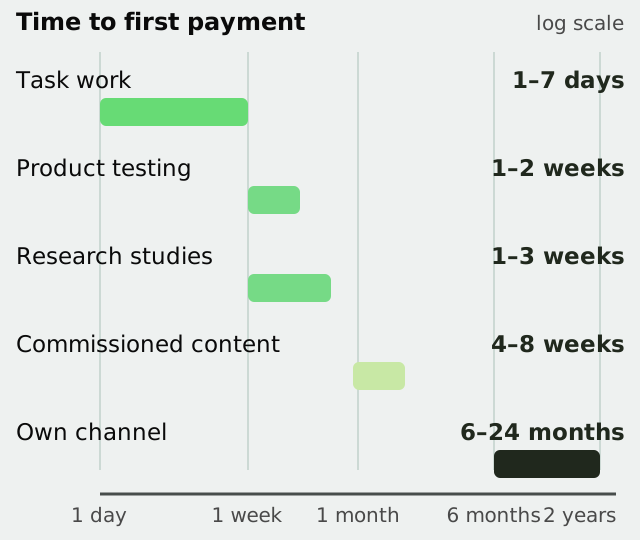
The row people wrongly rule out is the first. "No experience" nearly always means no freelance experience, which is a much smaller gap than having no sellable skill. Anyone who has held a job has been doing billable work for years without describing it that way — coordinating, chasing suppliers, keeping records accurate, handling upset customers, explaining a process.
What you need is evidence, not experience. Three spec pieces or two completed jobs closes the gap in a fortnight.
If you have a professional skill or a second language
Say so everywhere, immediately. These are the two highest-value things most people leave off a profile.
A professional qualification
Nursing, law, accountancy, engineering, teaching, professional programming. Business-to-business interviews and specialist feedback sessions pay more because the recruiting pool for "IT manager who evaluates software" is tiny.
Most people in qualifying jobs never look, because it does not feel like "work from home".
A language other than English
Translation, localisation, content review, and any geographically restricted task work. Non-English work is chronically short of people in almost every market and priced accordingly.
The scarcer the pair, the better it pays. This is the single most undervalued line on most profiles.
What to avoid, and why it finds you
People searching this phrase are the easiest group in the market to sell to, and the offers know it.
Four more patterns worth recognising. Pay described enthusiastically with the work never described. Earnings that depend on recruiting other people rather than on work you complete. Buy-and-refund product schemes, where you purchase the item and are promised a refund after posting a favourable review. And anything arriving as an unsolicited message after you posted somewhere that you needed money.
If your hours are unpredictable
The second question matters more than people expect, and it eliminates whole categories.
Unpredictable hours rule out anything with fixed live commitments — moderated research sessions, scheduled calls, real-time support cover, anything where somebody else is waiting. Taking those on with unreliable availability is how people end up working at 1am to avoid letting a client down, which is the fastest route to abandoning the whole thing. The weeknight version of that constraint is worked through in evening jobs from home.
What suits unpredictable hours is asynchronous work with a real deadline: task work you can complete in a twenty-minute gap, content briefs with a 48-hour window, written feedback, transcription. The deadline is real and the hours inside it are yours.
The one exception is a professional skill sold freelance. Client work has deadlines rather than hours, so it fits irregular availability well — provided you decline anything requiring daytime calls.
What "from home" rules in and out
Worth separating, because the phrase covers two different things.
Genuinely from home
Task work, testing, content production, freelance services, transcription, translation, research participation, virtual assistance. All of it happens at a desk or with a phone, at whatever hour you choose.
Local, not home
Mystery shopping, event work, product checks in shops. These pay well and they require you to be somewhere. Worth knowing they exist, and worth excluding if leaving the house is the thing you are trying to avoid.
The local category is frequently better paid per hour than the equivalent online work, because the eligible pool is everyone within driving distance rather than everyone with a laptop. What mystery shopping actually pays sets out that trade, including the travel cost that never appears in the listing.
The first month, honestly
Week one
Set up on one or two platforms. Complete every profile field, especially country, languages and devices — matching runs on those, and a blank field silently removes you from work you would have won. Expect to earn nothing.
Week two
Take small jobs and push one all the way through to a withdrawal in your own account, even for a few pounds. Completing that loop once teaches you more than any review.
Week three
Volume, now the process is familiar. Apply to everything you are eligible for in one category rather than scattering.
Week four
Calculate what you actually earned per hour, counting unpaid time. Drop the weakest source and put those hours into the strongest.
$50 to $250 in month one is normal and is not a signal to quit. Month two is usually double, because the setup cost is paid once and not paid again.
What your profile is actually for
Almost everybody treats the profile as a formality and then wonders why nothing arrives.
Matching runs on fields, not on prose. Country, languages, devices, operating system versions, age band, employment sector, whether you drive, whether you have children, what software you use at work. A blank field does not mean "ask me" — it means excluded, silently, from every job filtered on it. Nobody tells you what you missed.
The fields that most often turn out to be worth money are the ones people skip because they seem irrelevant: an old phone still in a drawer, a job title in a sector researchers pay to reach, a second language spoken imperfectly, living somewhere with few other panellists.
The other half is the part you write. Two or three sentences describing what you actually do, in the words a buyer would use, beats a paragraph of adjectives. "I proofread technical documents and I am fast with unfamiliar terminology" tells somebody whether to hire you. "Detail-oriented self-starter" does not.
Photographs and portfolios matter for content and creator work and matter almost nowhere else. If you are doing task work, testing or research, the fields are the thing.
The thing that decides the second year
Most routes have no rate curve. Basic task work pays the same in month twelve as in month one, however good you get at it.
The ones that climb do so because you become harder to replace — a specialism, a language, a portfolio, a client who returns. Adding hours has a hard ceiling at the number of evenings you own. Raising what an hour is worth does not.
That is the whole difference between a side income that stays at $150 a month and one that reaches four figures, and which options have a rate curve sets them against each other with the honest hourly for each. For the four-figure version specifically, what it takes to reach $1,000 every month starts from the rate rather than from a list.
For the wider question of what taking this work as a contractor actually costs you in protections and tax, gig work covers the part most guides leave out.