If you need to hire content creators for specific short-form videos, you should not have to open a permanent role or buy an agency retainer. RentHuman turns that request into a paid campaign with a fixed deliverable, rate per clip, number of spots and reviewable proof.
Most UGC platforms sit between you and the creator and take a cut of both sides. RentHuman does not set a price, does not represent the creator, and does not maintain a curated roster to sell you access to.
You publish a brief with a rate attached. Creators who match the eligibility rules reserve individual spots. You review each clip against the fixed brief; approval credits the creator, and an untouched submission approves automatically after the 48-hour review deadline.
That difference matters most when the campaign is unusual. A standing roster is fine when you want another skincare unboxing. It falls apart when you need forty people in three countries filming the same fifteen-second reaction to the same clip, this week.
What you actually get
A file, and a licence you specified. Not a managed service, not a creative strategy, and not a report.
Each submission arrives with the proof the brief demanded — the video, plus a posting link, a screenshot, or a written note if you asked for one. You review it against the requirements you wrote and approve or reject.
What you control on a brief
The public part is what creators read before deciding. The private part unlocks only after someone reserves a spot, which keeps unreleased product details, campaign URLs and promo codes out of a public listing.
- Rate per clip and number of spots. Funding is calculated as rate multiplied by spots, and the whole campaign is funded before it goes live.
- Geography. Worldwide, a region, specific countries, or specific cities. Language sits on top as a separate requirement.
- Proof format. Video file, posting link, screenshot, written note, or a combination. What you ask for is what gets checked at review.
- Who can take it. Open to anyone eligible, or restricted to creators you invite directly.
- Deadline. The window a creator has after reserving, before the spot releases back to the pool.
What to pay
You set the number, which means it is a decision rather than a lookup. Reasonable starting points for a straightforward short-form clip:
| Deliverable | Rate per creator |
|---|---|
| Simple first impression or unboxing | $40 – $80 |
| Standard short-form clip to brief | $80 – $150 |
| Scripted demonstration, multiple takes | $150 – $300 |
| Three hook variants from one creator | $200 – $400 |
Two things move those more than anything else.
Usage rights
A clip you can only post organically is a different product from one you can put ad spend behind for twelve months across three markets. State the licence in the brief and price it accordingly. Creators who discover the licence after delivery either dispute it or decline your next campaign.
Scarcity of fit
Narrow geography, a specific language, an unusual demographic or a regulated category all shrink the eligible pool. A rate that clears easily on an open global brief will not fill one restricted to a single city.
The licence line in the brief is what the price attaches to.
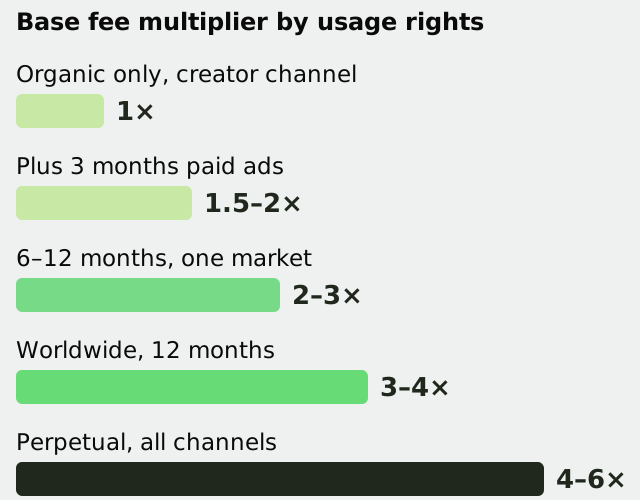
What creators understand by each licence tier is worth reading before you write the line.
Writing a brief that returns usable footage
The lines that actually decide whether a clip can run:
- The opening. Say what the first two seconds must contain. Highest-leverage line in any UGC brief and the one most often missing.
- Length, as a number with a tolerance. Not "short".
- Orientation and framing. Vertical, with headroom, because the platform crops.
- When the product must appear. Most viewers never reach second five.
- Audio. Whether they speak, whether you want ambient sound, whether you will add your own.
- What must not appear. Competitor products, other brands' logos, claims you cannot substantiate, music they do not own.
- Editing. Usually none — raw or lightly trimmed. Heavy edits read as an advert, which defeats the purchase.
- One example of good. A link to a clip in the style you want does more work than four paragraphs of description.
The full campaign guide covers how many clips to commission, how to review at volume, and how to measure whether it worked.
How the money moves
You fund the campaign up front, so every reserved spot is already covered and no creator works against an empty balance. Funding runs through Stripe, or through bank transfer with a unique reference that an administrator reconciles against the statement. A browser redirect never settles money on its own — only a verified webhook with a matching campaign, amount and currency does.
When you approve a clip, the campaign reserve is debited and the creator's balance is credited in one balanced ledger entry. Creators withdraw through Wise in reviewed batches, and the payout route states the currency and the timing.
If you never review a submission, it approves automatically after 48 hours. That is deliberate: it is the deadline creators are shown when they reserve, and it means nobody is left waiting indefinitely on a busy reviewer. Plan review time when you plan the campaign.
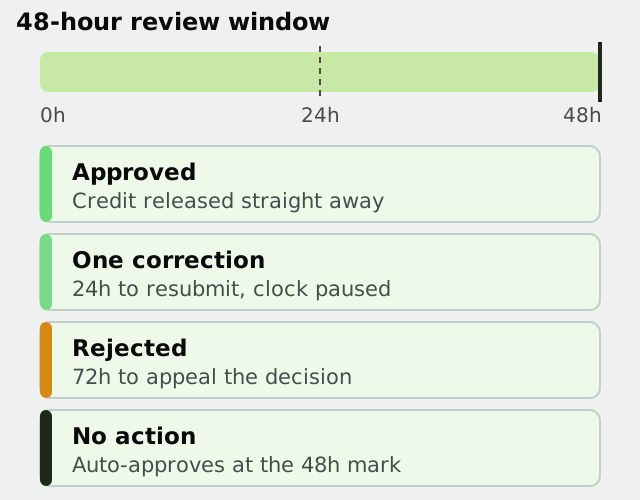
Reviewing without it becoming a week of work
Reviewing twenty clips is a different job from reviewing one.
Check against the brief, in order
Take your requirement list and work down it. Approve anything meeting the requirements even where you would have made a different creative choice — the variants you would not have picked are frequently the ones that perform.
Use the correction request specifically
One correction, naming exactly what to change. Vague notes produce a second draft with the same problem.
Decide the rejection standard before the first submission
Write down what constitutes a fail — a missed requirement, unusable audio, wrong length. Deciding case by case produces inconsistency that creators experience as arbitrary, and it is the fastest way to lose the ones you want back.
Why campaigns underfill
A campaign stalling at nine of twenty spots is the most common disappointment, and it is nearly always one of four things: the rate is below what the brief asks for, the geography is narrower than the supply, the requirements are unusual without extra payment, or the deadline is too tight for people with existing commitments.
The fix is rarely to wait. Raise the rate, widen the targeting, or relax whichever requirement is doing the filtering, then relaunch. A campaign sitting half-filled for a fortnight costs more in delay than the increase would have.
Getting creators to come back
The second campaign has much better economics than the first, and repeat creators are the reason. Someone who has delivered for you once knows the brief style, the review standard and the turnaround, so their next clip costs them less effort and costs you less review time.
Three things make that happen: review promptly rather than letting the clock run out, give a specific reason when you request a correction, and pay what you said on the terms you stated without renegotiating the licence after delivery.
None of that is generous. It is the difference between building a pool you can call on and starting from zero every quarter.
How this compares to the other ways of buying UGC
Four routes exist and they are priced for different problems.
A UGC agency. They write the brief, source the creators, manage delivery and hand you finished assets. Costs two to four times the creator rate, and for a brand with no in-house capacity that is often correct. You are buying the management layer, not the footage.
A curated creator roster. A platform vets creators and you pick from a list. Faster to a known-quality result, and the vetting is priced in. Works well for standard categories, poorly when your brief is unusual, because the roster was assembled for the standard case.
Direct outreach to creators. Lowest cost per clip and highest coordination burden. Viable for two or three creators, unworkable for thirty, and you carry the payment and contracting yourself.
A task marketplace. One brief, many spots, funded once, proof attached to each submission. How the five models compare in detail covers the choice properly. Lowest coordination cost at volume, and no management layer at all. The trade is that the brief has to be good, because nobody is between you and the creators to catch an ambiguity.
If you would struggle to write a brief that a stranger could execute without asking you a question, buy the management layer.
If you can write it, the management layer is a markup on something you already do.
What a first campaign realistically costs
Twenty clips at a standard short-form rate, with organic-only usage, lands between $1,600 and $3,000 depending on the rate you set. Add a paid-advertising licence and the same twenty clips cost meaningfully more, which is correct — you are buying a different asset.
Budget review time as well as money. Twenty submissions against a checkable proof standard take about half an hour to review. Twenty against a vague brief take an afternoon, plus a correction round, plus a second afternoon. The brief is where that cost is decided.
What we do not do
We do not buy engagement, generate accounts, or arrange reviews from people who have not used the thing they are reviewing. Those services exist and they are cheaper than this. They also breach the terms of every platform they touch, and they are the reason most microtask marketplaces cannot pass a brand's legal review.
Campaigns requiring any of that are rejected at moderation, before funding. what moderation actually refuses, and the audit trail behind it sets out what is enforced and how.
If your campaign needs disclosed, paid creator content from real accounts, with an audit trail attached to every payment, that is the case this platform is built for.
Getting a first campaign out
Start narrow rather than broad. Fifteen clips in two countries at a rate you would happily pay tells you more in a week than a hundred-spot campaign that half-fills.
Read what comes back before deciding anything about the second run. Most of what a first campaign teaches you is about your own brief, and that lesson is cheap at fifteen spots and expensive at a hundred. Once you know which rate clears in which market, the same brief scales without renegotiation.
Where the person on screen needs to be an actual customer rather than a commissioned creator, what a testimonial requires and where the disclosure line sits covers a different set of rules entirely.