Some questions have no expert answer. What a shelf looks like in twelve cities this week, whether a signup flow breaks on real phones on real networks, how a piece of content lands with forty people rather than with your team, whether a listing renders correctly for someone actually located in Brazil.
Software cannot answer those, and one freelancer cannot either. They need a distributed sample of people, each doing something small, each showing you what they found.
That is what this is for. It is deliberately not a place to hire a designer for three weeks. Reserved capacity is the part that separates this from open crowdsourcing, and the mechanism in full explains why. The practical comparison is whether you need one freelancer or many small proof-backed tasks.
When crowdsourcing is the right shape
Four patterns come up repeatedly.
Geographic sampling. The answer depends on where the person is. Regional pricing checks, local availability, how a service behaves from a particular country, what a market actually looks like rather than what the report says.
Real-world device and condition testing. A problem that only appears on a three-year-old phone on a congested network cannot be reproduced in a lab that does not own that phone. You need people with the hardware.
Sample-size feedback. One opinion is an anecdote. Forty structured responses to the same question, from people who match your buyer, is data you can act on. The value is in the count and the consistency of the question.
Content at volume. Thirty short videos from thirty different people, all answering the same brief. Not achievable by hiring one person, and tedious to arrange as thirty separate engagements.
How a campaign works
Write one brief
A public part everyone can read to decide whether they can do it, and a private part that unlocks only when someone reserves a spot. Campaign URLs, promo codes, exact instructions and anything competitively sensitive live in the private half.
Set the reward and the number of spots
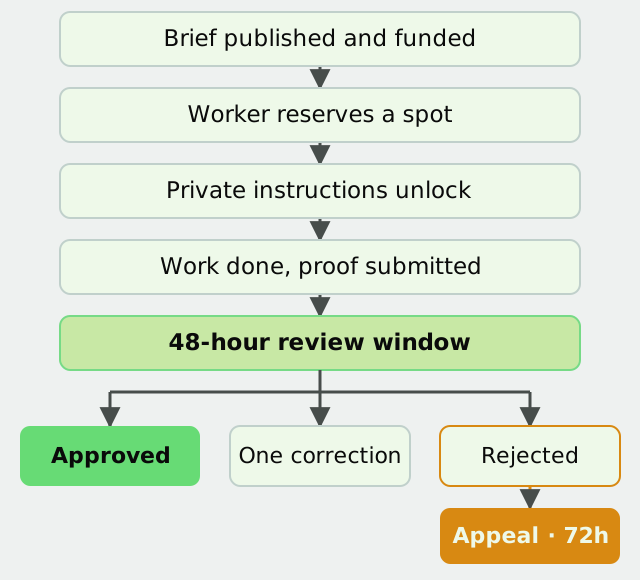
You decide the rate. Required funding is calculated as reward multiplied by spots and is committed before the brief publishes, so every reserved spot is already paid for.
Target who can take it
Worldwide, a region, named countries or named cities, with language requirements applied alongside. Eligibility is checked before someone can reserve, which is the difference between filtering and hoping.
Define the proof
A link, a screenshot, a photograph, a video file, a written note, or a combination. What you ask for is what gets checked at review, so ask for exactly what would convince you.
People reserve individual spots
Each reservation is one person committing to one unit of the work, with a time window. Unused reservations release and the capacity returns to the pool.
Review on a clock
Approve, request one correction, or reject. Unreviewed submissions approve automatically after 48 hours, so nobody waits indefinitely on a busy reviewer. Approval credits the worker and debits the campaign reserve in a single balanced ledger entry.
Those stages are fixed. The parts you choose are the brief, the rate, the targeting and the proof.
Getting quality out of a distributed sample
Quality in crowdsourcing is designed in at the brief stage. It cannot be added at review.
Ask a question that has a checkable answer. "Tell us what you think of the page" produces forty unusable paragraphs. "Photograph the shelf, note the price on the label, and say whether the promotional sign is present" produces forty comparable records.
Specify the proof precisely. Review speed is the constraint at volume. If review is a check against a list, you can do forty in an hour. If it is a judgement call each time, you cannot.
Restrict eligibility to people who can actually answer. Geography, language, and where relevant the device. How targeting decides who can reserve covers when to narrow and when narrowing just costs you fill rate. A well-targeted brief with fifteen eligible people beats an open one with four hundred applicants who cannot answer the question.
Pay a rate that attracts care. The relationship between rate and quality is not linear, but it is real. Underpricing fills slowly and attracts the least experienced, which produces the correction cycle you were trying to avoid.
Pilot before scaling. Twenty spots first. Read what comes back. Most of what you learn is about your own brief, and that lesson costs twenty rewards rather than two hundred.
Designing the brief for comparability
The single largest determinant of whether crowdsourced results are useful is whether the forty responses can be compared to each other. That is a brief problem, not a worker problem.
Ask one question at a time. A brief asking for a photograph, a price, an opinion on the packaging and a note about the staff will return forty responses with different subsets answered. Split it, or number the requirements and require all of them.
Give the format, not just the request. "Note the price" produces "about twelve euros", "€11.99", "cheaper than last time" and "didn't see one". Specify the format and you get forty numbers.
Provide the edge cases. What should someone do if the product is out of stock, if the page will not load, if the shop has closed? Without an instruction they will each improvise, and the improvisations are the responses you cannot use.
Ask for evidence alongside the answer. A photograph next to a stated price makes the record verifiable, and it changes how carefully people answer.
Pilot the brief on five people before funding fifty. Reading five responses tells you immediately which requirement was ambiguous. Fixing it then costs five rewards.
What it costs to run, beyond the reward
The reward is the visible cost. Two others decide whether a campaign was worth it.
Review time
At volume this dominates. A brief with a checkable proof standard takes about a minute per submission. A brief requiring judgement takes five to ten, which at fifty spots is most of a day. Designing for fast review is the highest-return thing you can do before launching.
Rework
Ambiguous briefs produce correction cycles, and a correction is a second review plus a delay. Every hour spent tightening requirements before launch removes several hours of this afterwards.
Both scale with the count, which is the real argument for piloting. Twenty spots with a sharp brief cost less in total time than fifty with a loose one, and teach you more.
Money and controls
Funding is calculated server-side from the reward and the spot count, so the total cannot be proposed by the client. Payment settles only on a verified webhook matching the campaign, amount and currency — a browser redirect never moves money on its own. Bank transfer funding is available with a unique reference reconciled against the statement, and one transaction reference cannot fund two campaigns.
On the worker side, approval writes a balanced append-only ledger entry, withdrawals require idempotency keys and move funds atomically, and payouts run through reviewed batches. Uploaded files are signature-checked and held in private storage that is never addressable from a public URL.
Rejections open a the appeal path open to a rejected worker decided by an administrator rather than by the poster who rejected the work. That is not a courtesy — a crowdsourcing platform where refusal is final and unexplained loses its worker supply, and a campaign is only as good as the pool willing to take it.
What gets refused
Campaign moderation happens before funding, not after complaints, and reviews both the public brief and the private instructions.
moderation, disputes and data handling in detail sets out moderation, disputes, data handling and the agent authority split in detail.
This costs revenue and it is the reason a campaign run here survives a brand's legal review. It is also why the payment processing underneath is not permanently one complaint from termination, which matters more to a buyer than it sounds.
Who does the work
Worth being straightforward about the supply side, because a buyer's results depend on it.
Workers activate through a verified identity and complete a profile that records country, city and languages. Regional campaigns check eligibility against that profile before anyone can reserve, so a brief restricted to Spain is answered by people in Spain rather than by people willing to claim it.
People take this work for the reasons anyone takes short paid work: it fits around other commitments, the units are small, and payment follows approval rather than an invoice cycle. That has an implication buyers sometimes miss — the pool responds to rate and to clarity. A well-written brief at a fair reward fills quickly because the people doing it can see immediately what is being asked and what it pays.
It also means the pool has a memory.
Campaigns that reject arbitrarily, request endless corrections, or set requirements that were not in the brief get avoided, and there is no way to buy back a reputation with the people who would have taken your next campaign.
Where this fits against the alternatives
Against a freelance platform: they are built to select one person for a contract. Thirty contracts is not a workflow anyone runs twice. Use them when you want expertise applied over time.
Against a research agency: an agency will run this for you with a project manager and a markup, and for a large or sensitive study that is often correct. Use this when you know what you want to ask and the coordination is the cost you are trying to remove.
Against building a panel yourself: viable at sustained scale and considerable overhead. Recruitment, verification, payment rails, dispute handling and tax reporting are the actual work, and they are the parts a platform exists to absorb.
Against automation: where software can answer the question, it should. This is for the questions where the answer requires a person in a place with a device and a judgement.
Starting
One brief, twenty spots, two markets, proof you would actually check. A rate you would accept if you were doing the work.
Fund it, watch it fill, and read the results before deciding anything about the second campaign. If the supply is not there for what you are asking, we would rather tell you before you fund it than after.