Search this and you get a hundred articles listing the same twelve reward apps, each promising a few hundred dollars a month for watching content you were going to watch anyway. The rates in those articles are almost never checked, and the reason is that checking them ruins the article.
Here is what the two versions of this actually pay, and how to find the one that is worth an evening. Two close relatives of this question get their own treatment: getting paid to scroll on TikTok and the Netflix version, both of which have the same shape and different answers.
The two things called the same name
Passive reward apps
You install something that plays video, often in the background, and accumulate points. Points convert to cash or gift cards at a rate the app usually does not display prominently. Effective earnings land somewhere between $0.10 and $1.00 an hour.
Paid video feedback
A company needs a real person to watch something — an advert before it launches, a competitor's campaign, a piece of content in a specific market — and report a genuine reaction. Sessions run fifteen to thirty minutes and pay $10 to $60.
The first is not a scam. It is simply worth almost nothing, and the gap between what it pays and what articles imply it pays is where most of the disappointment in this category comes from. The second is real work with a real rate, and it barely appears in the listicles because there is no affiliate commission attached to it.
Why the passive version pays so little
The arithmetic is not hidden, it is just rarely written down.
An advertiser pays somewhere between $5 and $30 to show a thousand video impressions. The app takes most of that. What reaches you is a fraction of a fraction of a cent per view, and a view takes fifteen to thirty seconds.
Run that forward and an hour of continuous watching generates a few dollars of advertiser spend, of which you see a small share. No amount of optimisation on your side changes the underlying number, because the ceiling is set by what the advertising is worth.
Three mechanics make the effective rate lower still:
Points, not currency. A "5,000 points" reward means nothing until you find the conversion, and the conversion is often buried in a help page.
Attention checks and caps. Daily limits on how much you can earn, and periodic prompts to prove you are present. The second is reasonable. Combined with the first, it means you cannot leave it running and cannot scale it either.
When passive apps are still worth it
Treat it as loose change. The failure is treating it as income and being disappointed for six months.
The version that pays properly
Companies need human reactions to video, and they need them from specific kinds of people, quickly. That demand is real and it is not well served.
Ad and creative testing. A brand has five versions of an advert and needs to know which one holds attention. You watch, you say where you lost interest, you rate what you remembered. Pays $10 to $40 for fifteen to twenty minutes.
Reaction content as a deliverable. Games companies, film marketing and music labels pay for genuine filmed reactions they can use or learn from. Rates run $15 to $200 depending on whether the footage is licensed for use.
User research sessions. Watching a product walkthrough and answering structured questions, sometimes live with a researcher. $30 to $60 an hour is normal, and moderated sessions pay at the top of that. It shades into usability testing, which is the same hour under a different name.
Localised content review. A brand launching in a market needs someone in that market to watch and flag what does not land — a joke that fails, a reference nobody recognises, a claim that breaks local advertising rules. Geographically restricted, which means less competition and better rates.
What all four share: you produce something. A rating, a written note, a recording, a decision. That output is what makes the hour worth $30 instead of 30 cents.
The devices and setup you need
Less than the category implies, and worth knowing so nobody buys anything.
For passive apps, nothing beyond the phone you own.
For paid feedback work, three things cover almost every brief. A device that can screen-record with audio, which every current phone and laptop does natively. A basic microphone if you are asked to speak your reactions, and a $25 clip-on is sufficient — the buyer wants clarity, not broadcast quality. And a quiet twenty minutes, which is the constraint people underestimate, because a recording with a television in the background gets rejected on a technicality rather than on content.
Filmed reactions add one requirement: a light source in front of you rather than behind. A window during the day solves it.
How to tell them apart before signing up
Six checks, all of which take under a minute.
Is the rate in currency
If earnings are quoted in points, coins, gems or credits, find the conversion before doing anything. If you cannot find it, that is the answer.
What is the withdrawal minimum
Divide it by the stated hourly rate. If the result is more than a few hours of work, the threshold is doing the real job.
Does earning require recruiting
Any structure where your income depends on people you sign up rather than work you do is not a job.
Are you asked to pay anything
For access, for a starter kit, for a premium tier that unlocks the good tasks. No legitimate work in this category charges the worker.
Is the money committed before you work
On a task marketplace, funded up front means the buyer's payment is already held. Unfunded means you are trusting a stranger to pay after you deliver, for a $20 job.
Can a rejection be challenged
This is the one people skip. If your submission can be rejected with no explanation and no appeal, you are carrying the entire risk of somebody's mood.
What a real session looks like
The structured version is more work than pressing play, and that is the trade.
You accept a task with the requirements visible — the video, the length, what you must produce, what you will be paid. You watch properly, usually once through and once with notes. You produce the deliverable: timestamps where attention dropped, a short written reaction, a screen recording with your voice, or a filmed reaction depending on the brief.
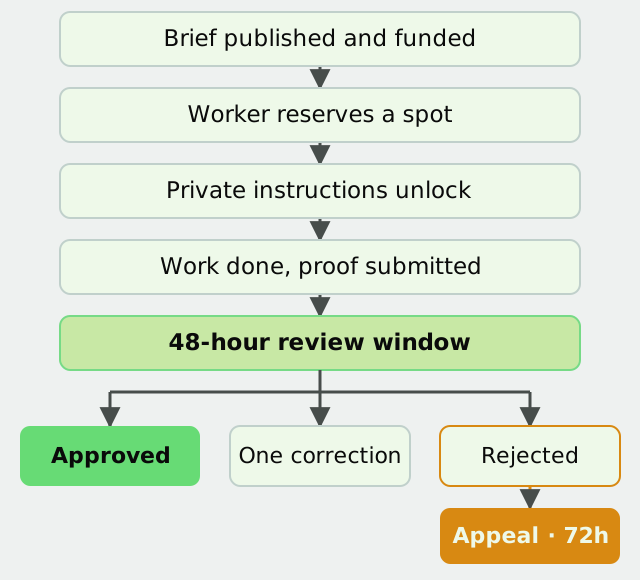
Then you submit and wait for approval. On a well-run platform there is a stated review window and unreviewed work approves automatically, so a buyer going quiet does not strand your payment indefinitely.
RentHuman campaigns show the reward, the eligible countries and the exact proof required before you reserve a spot. Campaigns are funded before they publish, posters get one correction request rather than unlimited revisions, and a rejection opens a 72-hour appeal decided by an administrator rather than the poster who rejected it. That is the shape worth looking for anywhere, not only here.
Why geography decides what you are offered
Eligibility surprises people, and it is worth understanding because it cuts both ways.
A great many video feedback briefs are restricted to specific countries. Sometimes that is because the product only sells there. More often it is because the whole point of the exercise is testing how content lands in one market, and a reaction from outside that market answers the wrong question.
That narrows what you can access. It also means the briefs you are eligible for face far less competition than an open global task, and they pay better for exactly that reason. A brief restricted to Dutch speakers in the Netherlands is competing for a pool of a few hundred people rather than a few hundred thousand, which is the whole mechanic behind country targeting.
Two things follow. Fill in your country and languages properly, because that is what the matching runs on. And if you speak a language other than English, say so prominently — multilingual feedback work is chronically short of people and priced accordingly.
What makes a reaction worth paying for
The skill in this job is not watching. It is noticing and being able to say what you noticed.
Timestamp things. "I lost interest around 0:14 when it switched to the product shot" is worth ten times "it was fine". Buyers are looking for the moment attention breaks, and a timestamp turns your opinion into something actionable.
Say what you remembered afterwards. Recall is the metric most advertisers actually care about. Watch, wait a minute, then write what stuck without rewinding.
Be specific about confusion. If you did not understand what the product does, say so plainly and say at what point. That is the single most valuable note anyone gives on an early cut, and most people soften it into uselessness.
Do not perform. Exaggerated reactions are obvious and worthless. The buyer is trying to predict how an ordinary viewer responds, and an ordinary viewer does not gasp.
Answer the question asked. If the brief asks for three specific things, deliver three specific things before adding anything else. Extra opinions are welcome after the requirements are met, not instead of them.
Creators who do this consistently get invited back directly, which is where the rate stops being the platform's rate and starts being yours.
Realistic monthly earnings
The middle figure depends heavily on how many briefs you are eligible for. The top one assumes you stop waiting for a single category to supply everything.
Nobody is making a living from watching videos. People do make a useful supplementary income from being reliably observant about them.
Building it into something steadier
Video feedback on its own is lumpy. Briefs appear when a campaign needs testing, not on a schedule, so a month with eight sessions can be followed by one with two.
Two things smooth that out.
Widen the task types you accept. The same profile that qualifies you for ad testing usually qualifies you for user testing, short written feedback, screenshot verification and localised content review. Treating them as one pool rather than four separate hustles roughly triples how many briefs you see.
Become someone a buyer asks for by name. Buyers running repeat campaigns keep a short list of people whose feedback was actually useful, and inviting a known person costs them nothing. Getting onto that list takes three or four clean deliveries: hit the requirements, meet the deadline, write notes specific enough to act on.
The second is where the rate stops being whatever the platform lists. Direct invitations skip the competition entirely, and buyers who ask for you by name rarely haggle.
Getting started this week
Skip the reward apps unless you specifically want background change.
Sign up to two or three places that carry structured video and feedback tasks. Complete your profile properly, including country and languages, because geography is what decides eligibility for the better-paid briefs.
Then take the first small task and follow it all the way through to a withdrawal, even for a few pounds. Completing the payment loop once tells you more about a platform than any review, and you learn it while your balance is too small to matter.
If the work suits you, widen out. Video feedback sits next to user testing, short-form content tasks and localised review, and the same profile qualifies you for most of it. The wider comparison of home side hustles covers what each of those pays per hour.