Most rate advice for this job is a single number, and a single number is why creators end up handing over perpetual advertising rights for the price of an organic post. What you are selling is not a video. It is a file plus a licence, delivered on a date, and each of those three is priced separately by anyone buying seriously.
Here is what each part is worth in 2026, and how to put them together into a number you can defend.
One framing worth holding onto before the numbers: a brand buying this content is not comparing your price to other creators' prices. They are comparing it to what the same asset would cost from a production company, which is an order of magnitude higher, and to what the asset will earn them.
Creators who price against other creators race each other downward inside a market that never asked them to.
The base table
Rates for a creator with a portfolio and a handful of credits, filming in a common market.
If the job itself is still new to you, what a UGC creator actually does covers the shape of the work before the money.
| Deliverable | Typical range |
|---|---|
| Simple unboxing or first impression | $15 – $60 |
| Standard short-form video to brief | $75 – $150 |
| Scripted demonstration, multiple takes | $150 – $300 |
| Video plus paid-ad usage rights | $250 – $500 |
| Bundle of 3–5 hook variants | $300 – $900 |
| Photo set, 5–10 images | $80 – $250 |
| Monthly retainer, 8–12 assets | $1,200 – $3,500 |
The bottom of that first row is the market floor rather than a fair price. Plenty of briefs offer $15 for an unboxing and plenty of people accept, which is what keeps the floor where it is. Our own guidance to buyers commissioning this work starts at $40 for the same deliverable, because a rate that only attracts people who have not yet worked out what their time costs produces exactly the content you would expect.
Treat these as the middle of the market rather than a ceiling. Creators with strong niche credentials, scarce languages, or specific regulated categories charge well above them.
Usage rights, which is where the money actually is
This is the single largest multiplier and the one most creators price at zero by accident.
| Licence | Multiplier on base |
|---|---|
| Organic post on the brand's own channel | 1× |
| Organic plus 3 months paid advertising | 1.5 – 2× |
| Paid advertising, 6–12 months, one market | 2 – 3× |
| Worldwide paid, 12 months | 3 – 4× |
| Perpetual worldwide, all channels | 4 – 6× |
| Whitelisting on your own handle | Priced separately, often 2× again |
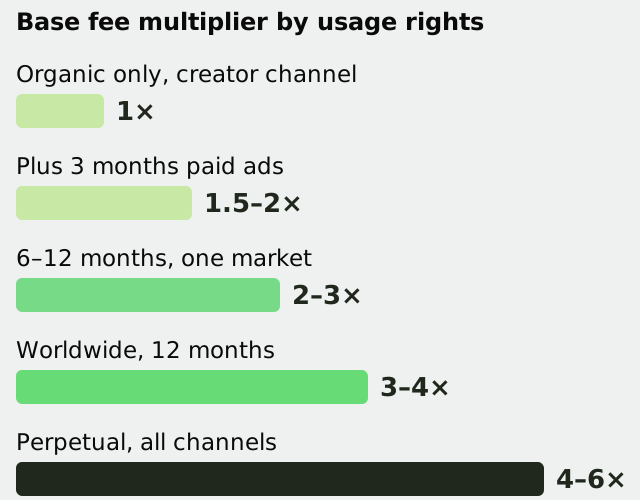
A clip running as a paid advert is not a post. It is an asset the brand puts money behind and earns from, potentially for years. The video that made a brand $80,000 in tracked revenue was not worth $75 to them, and pricing it at $75 because that is "the UGC rate" is the most expensive habit in this job.
What moves a rate up
Variants. Five different opening hooks on one setup is one afternoon of your time and five testable assets for a performance marketer. Bundle it at a per-clip discount and you still earn more per hour than five separate single bookings. This is the fastest way to raise effective rate without raising your headline price.
Turnaround. A guaranteed 48-hour delivery is worth a premium to anyone working to a launch date, and it costs you nothing except declining when you are already booked.
Scarcity of fit. Specific languages, specific countries, specific demographics, or a category where brands struggle to find credible creators. A German-speaking creator filming for a German market faces a fraction of the competition an English-language beauty creator does.
Regulated categories. Supplements, finance, health. Briefs are stricter, the claims are constrained, and fewer creators want the hassle. Rates reflect that.
Complexity of setup. Multiple locations, a second person on camera, props you have to buy, or anything requiring more than one session. Charge for the setup, not just the runtime.
What does not move a rate
Your follower count. The brand posts it on their channel. Your audience is not part of the transaction unless whitelisting is, and that is a separate line.
How long it took you. Getting faster should increase your effective rate, not decrease your price.
The product's retail value. A $12 product can be sold by a clip worth $400 to a brand spending $50,000 a month on ads.
Your experience in years. Nobody asks. They watch the portfolio.
Building an actual quote
Work it in this order rather than reaching for a single number.
Start with the base
Take the range for the deliverable format from the table above.
Apply the usage multiplier
Use the licence they are asking for, not the one you assume.
Add for setup complexity
Anything needing more than one session, or props you have to buy.
Add a rush premium
If the deadline is inside 72 hours.
Discount for volume
If they are booking a bundle or a retainer.
A worked example. A brand wants three hook variants of a 30-second kitchen product demonstration, with six months of paid usage in one market, delivered in five days.
No rush premium applies, because the deadline is comfortable.
Quoting $120 for that job, which is what a single-number approach produces, would have been an eighty percent discount that nobody asked for.
Agency rates, and why they differ
Work coming through a creative or performance agency generally pays fifteen to thirty percent below what the same brand would pay you directly. That is the agency's margin and it buys you something real: no prospecting, steady volume, and a client relationship somebody else maintains.
Two things to watch on agency work. Briefs tend to be tighter and deadlines shorter, because the agency has already committed a date to their client. And the usage licence is often written for the agency rather than the end brand, which can mean broader rights than you would grant directly. Read who the licence names.
Take agency rates when the volume is worth the discount. Decline them when the brief demands direct-rate effort at subcontractor pricing, which happens often enough to be worth checking each time.
Retainers
A retainer is the most valuable thing in this job and it is worth taking slightly below your per-clip rate to secure one. Predictable income, no prospecting, and a client who already knows how you work.
Typical shape: eight to twelve assets a month, invoiced monthly, with a defined licence covering everything produced in the period. Rates land between $1,200 and $3,500 depending on volume and usage.
Three terms to nail down before signing:
- What counts as an asset. Is a variant a separate asset or part of one? Agree this or you will be producing thirty things for the price of ten.
- Rollover. If the brand only briefs six assets in a month, does the balance carry forward or expire? Expiring favours you and is standard.
- Notice period. Thirty days on both sides is normal and protects you from a retainer vanishing the week you turned down other work for it.
Getting paid, and the terms that matter
Rate means little if the payment terms are bad. Before accepting:
When does the review clock start? On submission, or once files have been checked? The second is better for you, because nobody is timing you against work that has not been looked at.
What happens if the brand goes silent? A stated auto-approval window means unreviewed work pays out anyway. Without one, silence is an indefinite hold.
How many revisions? One correction with a deadline is reasonable. Unlimited revisions turn a $150 booking into a $30-an-hour one.
Is the money committed before you film? On a marketplace, funded up front means the platform holds the payment before the brief goes live. Unfunded means you are carrying the risk.
On RentHuman the rate, the eligible countries and the what counts as evidence of the work are all visible before a creator reserves a spot, campaigns are funded before they publish, posters get one correction request rather than unlimited revisions, and rejections open a what happens when a brand rejects the work decided by an administrator instead of the poster who rejected the work.
Rates by market
Where you live changes what you can charge, though less than most creators assume and not always in the direction they expect.
Rates are set mainly by the buyer's market, not yours. A US brand paying a creator in Portugal is budgeting against US creative costs, and a creator who prices against local wages is discounting for no reason. The brand is not comparing you to your neighbours; they are comparing you to the last clip they bought.
What geography genuinely affects:
Eligibility. Many briefs restrict to specific countries because the product ships there, or because the setting and accent are part of what is being bought. That narrows the pool you can access, and it also means the briefs you are eligible for face less competition.
Language. Non-English briefs consistently pay better relative to their difficulty, because the creator pool is small. If you work in a second language, say so prominently and expect it to be your best-paid work.
Payment friction. International transfers and currency conversion can quietly remove ten to twenty percent of a small payment. A $60 clip that lands as $48 has a different hourly rate than the listing implied. Check the withdrawal method, the conversion rate against mid-market, and any minimum threshold before committing to a platform. How payouts work sets out the version of that we use.
Time zone. The one place distance helps. Delivering overnight relative to the client reads as fast turnaround at no cost to you.
Negotiating without losing the booking
Most rate conversations are short and go fine. The ones that go badly usually do so because the creator either accepted silently or argued a principle.
Quote a number, not a range. A range is read as an invitation to pay the bottom of it.
Attach the number to the licence. "$300 for the video with six months of paid usage in one market, or $150 for organic only" gives the buyer a real choice and makes the licence visible as a priced item rather than an assumption.
When they say the budget is lower, reduce the deliverable rather than the rate. Fewer variants, a shorter licence, a longer deadline. Cutting the price alone teaches the client that your first number was decoration.
Do not justify. "My rate for that is $300" is a complete sentence. Explaining your costs invites a negotiation about your costs.
Know your walk-away and use it politely. "That is below what I can take on at the moment, but do come back if the budget changes." A meaningful share of those come back.
Get it in writing before filming. Rate, deliverable, licence, deadline, revision count. Five lines in an email. Nearly every payment dispute traces to something one side assumed.
Raising your rates
The mechanics are simpler than the anxiety around them suggests.
With new clients
Just quote the new number. There is no history to renegotiate and no conversation to have.
With existing clients
Raise at the start of a new campaign, not mid-flight. Give a reason, briefly: different usage terms, a longer deliverable, or a rate change at the start of the quarter. One sentence, no apology, no justification of your value.
Cadence: review after every five bookings. If every quote you send is accepted immediately, you are under-priced. A healthy rate produces occasional resistance, and the occasional lost booking is the cost of not leaving money on every other one.
The floor rises on its own as the portfolio fills with real client work. Swapping spec pieces for paid credits is what makes the higher number credible, which is why the two things move together.