Searching this usually means a specific bill with a specific date, which makes most of the answers unhelpful. A list of twenty ideas is not useful when what you need to know is which of them produce $500 before Friday.
Two routes reach that number, they work on completely different timescales, and which applies depends on something you can establish in five minutes.
The question that decides it
Do you own anything you could sell?
That sounds like a diversion from a question about earning, and it is the single most important thing to establish, because the arithmetic is not close. Paid work reaches $500 in twenty to forty hours. One unused phone reaches a meaningful fraction of it in an afternoon.
If you own sellable things
Sell first. A phone, a laptop, a games console, a bike, a watch, tools, a musical instrument. Most households contain several hundred pounds of unused equipment, and this is the only route that reaches the number in days rather than weeks.
If you genuinely do not
Then it is work, and the honest timeline is two to four weeks. Plan around that rather than against it, because every route promising to compress it is either in-person and physically demanding or is not what it claims to be.
Most people searching this are in the first group and have not counted. Doing the count takes twenty minutes and frequently answers the question outright.
Selling, in the order that works
Electronics first
Phones, laptops, tablets, consoles, cameras. Highest value per item, most liquid market, and buyback services give a guaranteed price within days even though it is below what a private sale would fetch.
Then anything with a model number
Tools, instruments, bikes, appliances. Buyers search by model, so these sell quickly at a fair price without much effort on your part.
Then bulk items
Clothes, books, games, kitchen equipment. Low value each and slow to move. Worth doing while waiting for the first two rather than as a plan of its own.
Set a deadline price
Decide what you will accept by day three and take it. Holding out for the best price is reasonable when you have time and expensive when you do not.
Earning, and the real timeline
If selling is not available, this is the honest arithmetic. At $12 to $30 an hour — the realistic band for work that accepts people immediately — $500 is twenty to forty hours.
| Route | Hourly | Hours to $500 | First payment |
|---|---|---|---|
| Task and testing work | $12 – $30 | 17 – 42 | 1 – 7 days |
| Local in-person work | $15 – $40 | 13 – 33 | 1 – 3 weeks |
| Research participation | $30 – $100 | 5 – 17 | 1 – 3 weeks |
| Freelance a work skill | $25 – $80 | 6 – 20 | 2 – 6 weeks |
| Surveys | $1 – $4 | 125 – 500 | weeks |
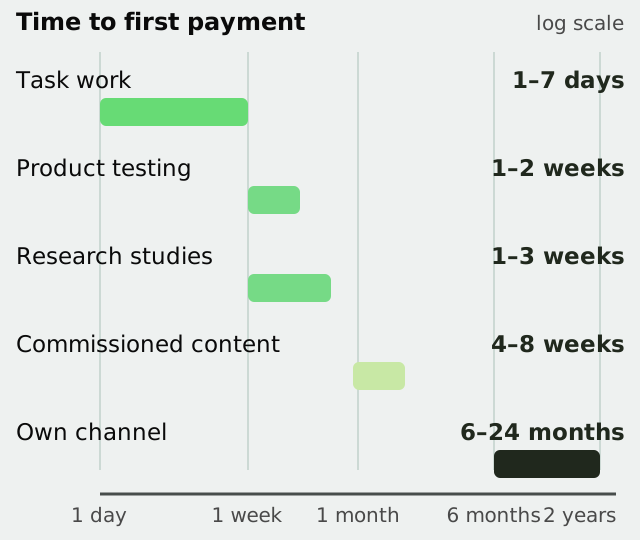
Two rows deserve comment.
Research participation has the best hours-to-target ratio on the table and the worst reliability, because qualifying is the constraint rather than availability. A single ninety-minute session can pay $150, and you may be screened out of nine before reaching one. Worth applying to broadly and worth not depending on.
Surveys are on the table only to rule them out. At $1 to $4 an hour effective, $500 is several hundred hours, and screen-outs are unpaid. They are the most recommended answer to this question and among the worst.
The gap between the top and bottom of that table is a factor of fifty. Nothing about the hours you have changes it — only what you are eligible for does.
What actually moves the rate
Since the timeline is set by your hourly, the useful question is what raises it, and three things do it quickly enough to matter inside a month.
A professional qualification. Business-to-business research pays $200 to $600 an hour for people in specific roles — clinical, legal, financial, engineering, senior IT — and most people in those jobs never look, because it does not present itself as urgent-money work.
A language other than English. Translation and localisation pay several times what general task work does, and non-English markets are short of people almost everywhere.
Being physically available. Local in-person work — mystery shopping, event staffing, product checks — pays better per hour than the online equivalent because the eligible pool is everyone within driving distance rather than everyone with a laptop. What that work pays once travel is counted is worth reading before accepting a route of them.
Two things worth checking on any platform
Before spending an evening on somewhere you have not used, two questions settle most of it.
Is the work funded before you start it? Money committed up front means the buyer cannot disappear after you deliver, which is the failure mode that costs people the most when they are working to a deadline.
And what happens if the buyer simply stops responding? Somewhere with no clock running in your favour is somewhere a silent buyer holds your payment indefinitely, and you find that out in the week you can least afford it.
What is targeting this search
People looking for a specific sum quickly are among the most reliably targeted groups online, and the offers are built around exactly that.
Four more patterns, all of which cluster around urgency.
Money-transfer and package-forwarding roles, frequently advertised as payment processing or logistics assistance. These are money laundering and parcel fraud, the participant is the person identifiable to law enforcement, and the framing is deliberately reassuring.
Buy-and-refund schemes, where you purchase a product and are promised repayment plus a fee after posting a favourable review. The refund often does not come, and the review is fraudulent regardless.
Unsolicited approaches after you have posted anywhere that you need money. Someone reading that and messaging you is responding to your urgency, not to your suitability.
And anything where the pay is described enthusiastically while the work is never described at all.
Urgency is not a reason to lower the bar. It is the precise condition these offers are built to find.
A realistic seven days
If you need the number soon and are starting from nothing today, this is the sequence that produces the most by day seven.
Day one
Count what you could sell and list the top three items. Register on two task or testing platforms and complete every profile field. Neither takes long and both have to happen before anything else works.
Days two to three
Reduce prices on anything unsold and accept a reasonable offer rather than holding out. Start taking small tasks — the objective is getting one payment through to your own account so you know the loop works.
Days four to five
Apply widely to research panels and local in-person work. These have the best rates and the longest lead times, so applying late is the common mistake.
Days six to seven
Concentrate on whichever source has actually paid you. By now one will be clearly better than the others, and splitting attention across four is what stops any of them reaching a useful total.
Expect selling to produce most of the total and work to produce the rest. That ratio inverts after the first fortnight, which is the argument for continuing past the immediate deadline rather than stopping the moment the bill is covered.
If it is not going to be enough
Worth saying plainly, because the alternative is worse: sometimes $500 by Friday is not achievable, and knowing that on Tuesday is more useful than discovering it on Thursday.
If the money is for a bill, contacting the organisation before the date is nearly always better than after. Payment plans, deferrals and hardship arrangements exist at most utilities, lenders and councils, and they are considerably easier to arrange before a missed payment than afterwards. That is not a substitute for earning, and it changes the deadline you are working to.
What is worth avoiding is a high-cost short-term loan taken to bridge a gap that a payment plan would have handled. The cost of that decision usually exceeds the amount by a wide margin, and it is made under precisely the time pressure that makes it hard to evaluate.
After the deadline
The routes that reach $500 quickly are mostly routes without a rate curve. Task work pays the same in month six as in week one, and selling possessions works exactly once.
If the underlying situation is that the income does not cover the outgoings, the thing worth building is different from the thing worth doing this week. Which options have a rate curve and which stay flat sets them against each other honestly, and the three questions that narrow it to one route is the faster way in if you are choosing rather than comparing. Where the gap is a recurring one rather than a single bill, the arithmetic for an extra $1,000 every month is the version of this that assumes month four exists.
For the immediate week, what genuinely accepts beginners and pays within days is the practical list, and the twelve-point check on any platform is worth running before spending an evening on any of them.