Every marketplace for small paid work has to answer one question: what happens when the buyer says no.
The answer determines more about whether the marketplace functions than the rates do. Where a rejection is final and needs no explanation, every hour a worker invests carries a risk they cannot price, and the people who can work elsewhere do. What remains is a pool that has not yet learned, which is a supply problem the buyer eventually pays for. An appeal route is part of the integrity model rather than a concession to it, as this argument sets out.
The sequence
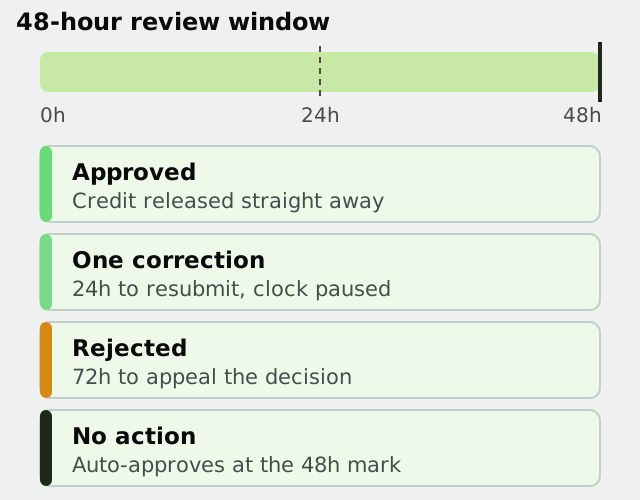
A submission arrives and the review clock starts — 48 hours, beginning once any uploaded files have cleared safety review rather than at the moment of submission. Nobody is timed against media that has not been looked at. The poster has three options within that window.
Approve
Credits the worker's balance and debits the campaign reserve in one balanced ledger entry, on the same payout path as everything else.
Request one correction
Pauses automatic approval and gives the worker 24 hours to resubmit. One per submission, and it must be against the requirements the brief already stated.
Reject
Opens the worker's appeal window.
Do nothing
The submission approves automatically at the end of the 48 hours.
What a rejection is judged against
The brief, as it was written before the worker reserved the spot. Not a preference formed after seeing the work.
That distinction is the whole of it. A submission meeting the stated requirements should be approved even where the poster would have made a different creative choice, because the worker committed to a specification and delivered against it. Wanting something different afterwards is a reason to write a better brief next time, not a reason to withhold payment for this one.
The appeal
A rejected worker has 72 hours to appeal. An administrator reviews the submission against the brief and decides — not the poster who rejected it.
How to specify proof so this rarely arises is the practical companion to this page.
An appeal decided by the person who made the original decision is not an appeal.
That independence is the point, and marketplaces describing a complaints inbox as an appeal are relying on nobody checking.
Where an appeal succeeds, settlement runs through the same retry-safe path as an ordinary approval. The ledger entry is balanced and idempotent, so a reversal cannot pay twice, pay half, or leave a campaign reserve and a worker balance disagreeing with each other. That property matters more than it sounds — reversals are exactly where naive financial code produces inconsistencies, and they surface weeks later as balances nobody can reconcile.
Where an appeal fails, the rejection stands and the campaign capacity returns to the pool.
For posters
Decide your rejection standard before the first submission arrives. Write down what constitutes a fail — a missed stated requirement, unusable audio, wrong length, an illegible photograph.
Deciding case by case across forty submissions produces inconsistency that workers experience as arbitrary, and arbitrary rejection travels. A campaign that rejected unpredictably last month fills slowly this month and nobody explains why. A written standard also makes any appeal simple to resolve, because there is something to check the decision against.
Use the correction request rather than rejecting where the work is fixable. It costs you one round and it is the difference between a creator who returns and one who does not.
And review promptly. Letting the clock run to automatic approval is a legitimate outcome, and doing it habitually tells the pool you are not paying attention, which affects who takes your next brief.
For workers
Read the proof requirement before reserving rather than after completing the task. Most rejections trace to a stated requirement that was missed, and those appeals do not succeed because the requirement was there to read.
Submit exactly what was asked, in the order asked. Extra material after the requirements are met is fine; extra material instead of them is a rejection.
If you are rejected and you did meet the brief, appeal. The process exists to be used, and using it is not held against you. Point at the specific requirement and how your submission met it, rather than arguing that the work was good — the appeal is decided on the specification, not on quality in the abstract.
If you did miss something, the honest read is usually visible on re-reading the brief, and the useful response is the next brief rather than the appeal.
The disputes that actually happen
Across small-task work, the same five disagreements recur, and four of them are preventable at the brief stage.
A stated requirement was missed. The most common by a wide margin, and it resolves quickly because the brief settles it. Prevention is a numbered requirement list rather than a paragraph.
The requirement was ambiguous. Two careful people would have read it differently, and the worker read it the other way. These are the appeals most likely to be overturned, and the finding belongs to the poster: the brief needs fixing before the next campaign.
The work is technically compliant and not what the poster wanted. Approved on appeal, generally, and it is the clearest signal that a brief described the deliverable without describing the purpose.
Quality is genuinely below a usable standard. Illegible photographs, inaudible audio, a video at the wrong length. Rejections here are upheld, and workers can avoid nearly all of them by checking their own submission before sending.
Something outside the worker's control. A page that would not load, a shop that had closed, a product that was out of stock. These are avoidable entirely by covering the failure case in the brief and saying what to submit when it happens.
Four of those five are brief problems. A poster seeing repeated disputes on a campaign is usually looking at a specification issue rather than a worker-quality issue, and that reframe is worth more than any individual decision.
Why the timings are what they are
Each window in this process is a trade-off between two people's interests, and the reasoning is worth stating.
Forty-eight hours for review is long enough for a poster to get to a batch of submissions around other work, and short enough that a worker is not waiting a week to know whether they have been paid. Longer would shift the cost of a busy reviewer onto the worker.
Twenty-four hours to respond to a correction is tight deliberately. A correction is a small fix against requirements that already existed, not a new brief, and a longer window would let a poster hold a submission open indefinitely by requesting changes.
Seventy-two hours to appeal is longer than either, because a rejection arrives unexpectedly and the worker may need to re-read the brief, gather what they submitted and write a case. Rushing that would make the right to appeal nominal.
And automatic approval exists because the alternative — a submission with no deadline — is the single most common way workers lose money in this category. A clock that runs out in the worker's favour is what makes the whole arrangement safe to enter.
Why this term is worth checking anywhere
Whatever platform you use, this is the term most worth establishing before you invest time in it, and the one least often stated on a marketing page.
Ask three things.
Is there a stated review window
And does unreviewed work approve automatically, or can a quiet buyer hold a payment open indefinitely?
Can a rejection be challenged
And who decides it — an administrator, or the person who rejected the work?
How many revisions can a buyer demand
One correction against the original brief is reasonable. Unlimited revisions turn a fixed reward into an open-ended job.
A platform answering all three clearly has thought about the failure case. One that cannot answer has left the risk with whoever is least able to carry it, and the rates on offer do not compensate for that. The full check for any task platform covers the rest of what is worth verifying.
Moderation, which happens before any of this
Worth mentioning because it prevents a whole class of dispute that would otherwise reach the appeal stage.
Campaigns requiring accounts to be created on somebody else's behalf, reviews from people who have not used a product, engagement presented as organic, or anything breaching the terms of the platform where the work would happen are rejected there.
The reason this belongs on a disputes page: work that should never have been commissioned generates disputes that no appeal process can resolve fairly. A worker who completed a task that breaches a third party's rules is in a bad position whichever way the decision goes, and the honest fix is upstream. What moderation refuses and why sets out the full boundary.
Keeping your own record
Small habit, occasionally decisive.
Workers on any crowdsourcing platform should keep a copy of what they submitted until payment confirms — the file, the note, the link, and the time it was sent. Uploads occasionally fail in ways nobody notices until review, and being able to resend immediately turns a lost afternoon into a two-minute correction.
Posters should keep the brief as published, including any correction requests sent. Where a campaign runs several times with an evolving brief, an appeal is decided against the version the worker actually reserved under, and having that version to hand resolves it in one exchange rather than three.
Neither is onerous and both remove the class of dispute where two people remember a requirement differently and neither can show it.
What this does not solve
It does not prevent ambiguity
An ambiguous brief still produces disputes, and an appeal process handles them rather than preventing them. The prevention is upstream: state the requirements precisely, cover the failure cases, and specify proof you will actually check.
It does not guarantee a correct decision
An administrator reviewing a submission against a brief is making a judgement, and judgements are occasionally wrong in both directions.
What the process guarantees is that the judgement is made by somebody with no interest in the outcome, on a stated timescale, against a written specification — which is the most any dispute mechanism can offer and considerably more than the category norm.