Searching for side hustle jobs turns up two things: job boards full of full-time roles that do not fit around anything, and listicles telling you to start a podcast. Neither is a list of places where somebody will pay you next week.
The useful framing is that most side income is not advertised as a job. It is advertised as a task, a brief, a study, a contract, or nothing at all. Knowing which word each source uses is most of the search.
The four places work is actually posted
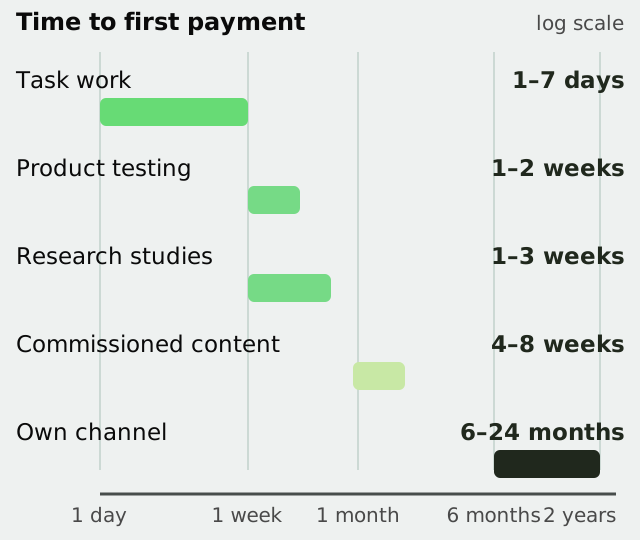
| Source | What it is called there | Typical rate | Time to first booking |
|---|---|---|---|
| Task and campaign marketplaces | Tasks, briefs, campaigns | $10 – $30/hr | Days |
| Freelance platforms | Projects, contracts | $20 – $60/hr | 2 – 6 weeks |
| Research and testing panels | Studies, sessions | $15 – $60/hr | 1 – 3 weeks |
| Job boards, filtered | Part-time, contract, casual | $12 – $40/hr | 2 – 8 weeks |
| Direct outreach | Nothing, it is unadvertised | $25 – $80/hr | 4 – 12 weeks |
The last row is not a typo about time. It is slow to start and it pays the most, because you are not competing with anyone who found the same listing.
Task and campaign marketplaces
Businesses post small, specific jobs with the payment attached: film a short clip, test a signup flow, check how a page renders in a particular country, give structured feedback on a product. You take one, complete it, submit proof, get paid on approval.
This is the fastest route from nothing to a first payment. No portfolio, no interview, no clients. The trade is that it does not accumulate — finishing one task leaves you exactly where you started for the next.
Use it for immediate money while something with a rate curve builds behind it.
Freelance platforms
Bigger units of work, longer commitments, better rates. The competition is heavy at the entry level and thins out sharply once you have a specialism and a few reviews.
The mistake beginners make is applying to everything. Ten targeted proposals in one category beat sixty generic ones, and the sixty generic ones cost more time.
Research and testing panels
Companies pay to watch real people use their products. Unmoderated sessions where you record yourself run $10 to $30 for fifteen minutes. Live sessions with a researcher run $40 to $150 an hour.
Excellent rate, unreliable volume. Most people get a handful of invitations a month, so it supplements rather than sustains. Sign up to several panels rather than one, because eligibility is narrow and each screens on different criteria.
Job boards, filtered properly
Ordinary boards do carry side-shaped work if you filter for part-time, contract, casual, weekend or freelance. Evening and weekend roles in tutoring, bookkeeping, customer support and events all appear here. Where the platform itself is the constraint, the Fiverr alternatives worth considering compares the options. Organised by when you are actually free, the options split into evening and weekend work.
This is the only source on the list where the work might be actual employment, with the protections that implies. Worth checking for that reason alone.
Direct outreach
Not a listing at all. You identify businesses with a problem you can solve and contact them.
It feels like the hardest option and it is the highest-paid, and those two facts are the same fact. The discomfort is what keeps the rate up, because most people take a lower-paid listing to avoid sending the email.
Start with people who already know your work: former colleagues, small businesses you use, anyone who has seen you do the thing. A single retained client at four hours a month often out-earns everything else on this list combined.
Writing is the most common skill people already have and undervalue; what freelance writing pays now covers where that market split.
Applying so that you get picked
Whatever the source, reviewers work the same way. They filter on stated requirements, then skim, then decide. Almost every rejection happens at the filter, before anyone forms an opinion of you.
Answer the requirements explicitly
If the listing asks for someone in Germany who can deliver within 48 hours, your first line confirms both. Do not make a reviewer infer eligibility from your profile.
Reference the actual listing
One specific sentence proving you read it beats three paragraphs about your work ethic. "You mentioned the checkout flow — I'd test it on both mobile browsers and note where the form resets" is a better application than any biography.
Keep it short
Four to six sentences. Long applications correlate with people who did not know what to say.
Show relevant work, not all work
One sample matching the category beats a portfolio of nine spanning everything.
Apply early
Most listings are filled from the first day's applicants. A brief posted three days ago with sixty responses is worth less of your time than one posted this morning.
Do not negotiate before you are chosen
Rate discussions belong after they want you, not in the application.
Listings worth skipping
Pay described, work not described. "Earn $600 a week from your phone" with no statement of the task. Real listings say what the job is because they need someone able to do it. For choosing which route to look for in the first place, start with how to pick one.
Payment after an unspecified review, with no money held. If the buyer has not committed funds before you start, you are extending credit to a stranger for a $20 job.
Any request for money from you. Training, starter kits, background checks you fund, premium tiers that unlock the good tasks. None of these exist in legitimate work.
Recruitment-based earnings. If your income depends on people you sign up rather than work you complete, the structure is the product.
Rejection with no appeal. The one most people never check. If work can be refused with no explanation and no route to challenge it, every hour you invest carries a risk you cannot price. Look for a stated review window, automatic approval if a buyer goes silent, and somebody neutral deciding a dispute.
Vague "flexible" language covering unpaid time. Some roles pay only for productive minutes while requiring you to be available for hours. Check what is compensated, not what is scheduled.
Keeping it alongside a main job
The failure mode here is rarely the work. It is the collision between side work and the job that pays the rent.
Read your employment contract first. Exclusivity clauses, outside-work clauses and conflict-of-interest terms are common in salaried roles, and they are enforced more often than people expect. Most permit outside work that does not compete and does not use company time or equipment. Some require you to notify. A few prohibit it outright, and finding that out after a client relationship exists is worse than finding out now.
Never use work equipment or accounts. A personal laptop, a personal email address, personal cloud storage. This is not paranoia — it removes any argument about ownership of what you produce, which in some contracts is a real question.
Do not commit to hours you do not control. A main job that occasionally runs late rules out anything with fixed live sessions. Asynchronous work you can complete at any hour is the compatible shape, and choosing it over higher-paid work with fixed timing is usually correct.
Fix a stopping point. Side income expands to fill available time, and available time is usually rest. A defined block — two weekday evenings and a weekend morning — outlasts an open-ended commitment by a wide margin.
Watch the first three months. That is when enthusiasm produces overcommitment, and overcommitment produces the tired month where people quit. Take less than you think you can handle initially and add later.
What the people who earn most do differently
Comparing someone earning $80 a month with someone earning $2,000 from the same starting point, the differences are consistent and none of them are about talent.
They picked one thing. Depth in a single category produces repeat clients. Breadth across five produces five shallow profiles and no reputation anywhere.
They chased repeat work rather than new listings. A client who books you a second time costs nothing to acquire. Most people spend every hour applying and none of it on making the last client want to come back.
They raised the rate. Not once, repeatedly, in small increments, at the start of new engagements. The rate you set in month one has no claim on month eight.
They tracked the real hourly number. Including unpaid application time, admin, and revisions. Advertised rates and effective rates diverge enormously, and only the second one tells you what to drop.
They finished cleanly. Delivering on time, in the format asked for, without argument on the first round of notes. Reliability is scarcer than skill in this market and it is the whole basis of being asked back.
They treated rejection as information. Almost every rejection traces to a stated requirement that was missed. The people who improve read the brief again; the people who stall conclude the market is saturated.
The wider question of what contracting costs you in protections and tax is covered in gig work. Community recommendations are worth reading critically; what Reddit actually recommends, tested against the numbers sorts the useful from the merely repeated.
What these jobs are, legally
Nearly all of it is self-employed or contract work, not employment. That has consequences worth knowing before the first payment rather than after the tax year.
What you do not get
No holiday pay, no sick pay, no notice period, and no minimum-hours guarantee. You can generally work for competing clients simultaneously, unless a contract says otherwise, which is worth reading for.
What you take on
Your own tax, usually from the first payment rather than after some threshold. Keep a record of every payment — date, payer, amount, and anything you spent to earn it — and set aside a fixed percentage of each payment as it arrives rather than meeting a bill by surprise.
One more thing belongs in the same reading pile.
A four-week plan that produces something
Week one — set up properly, once
Register on two task or testing platforms and one freelance platform. Complete every profile field, especially country and languages, because those decide eligibility for a large share of the better-paid work. Expect no income this week.
Week two — volume on the fast sources
Take small tasks and complete one all the way through withdrawal, even for a few pounds. Completing the payment loop once tells you more about a platform than any review, and you learn it while the balance is too small to matter.
Week three — add the slow, high-rate channel
Twenty direct outreach emails to businesses in your category. Four sentences each. This produces nothing yet and it is the thing that pays best in month three.
Week four — measure and cut
Calculate what you actually earned per hour, counting unpaid application and admin time. Drop the lowest source and put those hours into the highest.
A first month between $50 and $250 is normal. The second month is usually double, because the setup cost has already been paid and is not paid again.
Moving up rather than out
The instinct after a decent first month is to add a second hustle. It is usually the wrong move.
Adding hours has a hard ceiling: your evenings. Raising the rate on the hours you already work does not.
A person moving from general task work into a specialism — content, research, a professional skill applied freelance — roughly doubles the rate on the same time.
That transition is the only reliable way this becomes meaningful money. The wider comparison of home side hustles sets out which options have a rate curve and which stay flat however good you get at them.
One category on that list is less understood than it should be, and it pays for being somewhere rather than for a skill — what mystery shopping actually is explains the method before you judge the rates.