Virtual assistance is the side hustle most compatible with a full-time job, because clients buy small blocks of hours and rarely care when in the day you use them.
It is also two different jobs sharing a name. General admin support competes globally on price and pays accordingly. Specialist support competes on whether you can do a specific thing, and pays two to three times more. The whole question is which one you position yourself as, and it is decided in the first fortnight.
What clients actually outsource
Not what job descriptions say. What small business owners actually hand over, roughly in order of how often:
- Inbox triage. Sorting, drafting replies, flagging what needs the owner. The most common first task and the one that builds trust fastest.
- Calendar and scheduling. Bookings, rescheduling, coordinating across time zones.
- Customer support. First-line responses, order queries, refunds within a policy.
- Invoicing and payment chasing. Sending, tracking, following up. Unglamorous and immediately valuable, because owners avoid it.
- Bookkeeping preparation. Categorising, reconciling, preparing what the accountant needs. Higher paid and requires care.
- Research. Suppliers, competitors, prospect lists, options for a decision.
- Social media scheduling. Posting to a plan somebody else set. Not strategy, and pretending otherwise is where VAs oversell.
- Data and CRM hygiene. Deduplicating, updating, keeping records usable.
- Travel and logistics. Booking, itineraries, changes.
- Process documentation. Writing down how something is done so it can be handed to somebody else. Quietly one of the best-paid things on the list.
The pattern in what pays most: tasks where a mistake costs the client real money, and tasks that require holding context rather than following steps.
What it pays
| Type of work | Hourly |
|---|---|
| General admin, entry level | $12 – $18 |
| General admin, experienced | $18 – $25 |
| Customer support with product knowledge | $20 – $30 |
| Bookkeeping and financial admin | $30 – $50 |
| Executive assistance | $35 – $60 |
| Platform-specific administration | $35 – $70 |
| Process and operations documentation | $40 – $70 |
The bottom two rows of the general section are where most people start and where most people stay, and staying there is a choice rather than a market condition.
Platform-specific deserves explanation because it is the most accessible jump. Businesses run on tools they do not understand — an e-commerce backend, a booking system, an email platform, a project tool, an accounting package. Someone who genuinely knows one of those charges two to three times general admin rates, and learning one properly takes weeks rather than years.
What changed
What software took
Scheduling assistants, automated categorisation, first-pass email sorting and template responses all work well enough now that paying somebody hourly for them is difficult to justify. That removed the bottom of the market.
What it left, and grew
Anything requiring judgement, context, or accountability: deciding which of forty emails actually matters to this particular owner this week, noticing that an invoice does not match a delivery, handling a customer whose situation is not covered by the policy, and being a person the owner can hold responsible.
The same pattern shows up across administrative work generally.
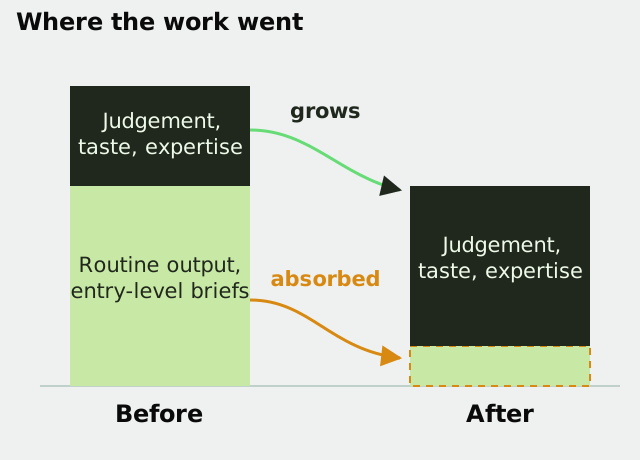
The practical read is the same as everywhere else in freelance work. Do not compete on tasks that can be automated. Compete on the ones where somebody needs a person to have looked at it.
Getting a first client
The barrier is proof you can do something, and it is lower than people assume.
Inventory what your current job actually contains
Most people in any coordination, administrative or customer-facing role are already doing six sellable things and have never described them as services. Scheduling across teams, chasing suppliers, keeping a system tidy, handling complaints, preparing reports: all of that is billable work, which is why this is one of the few online jobs needing no prior experience in the field itself.
Pick a specialism before you pick a client
"Virtual assistant" competes with everyone. "Bookkeeping support for small e-commerce businesses" or "inbox and customer support for coaching practices" competes with almost nobody, and the client searching for exactly that pays more.
Start with people who already know you
Former colleagues, small businesses you use, anyone who has seen you work. The first client almost never comes from an application.
Then approach small businesses directly
Find ones visibly drowning: slow replies to reviews, an owner answering their own social media at 11pm, a booking system with obvious gaps. Four sentences saying what you noticed, what you would take off their hands, your rate, your availability.
Agencies as a parallel track
VA agencies subcontract and pay below direct rates, in exchange for you never prospecting. Reasonable while direct outreach warms up.
Pricing it
Hourly for ongoing work, project rates for defined pieces. Retainers of a fixed monthly block are the goal, because they make income predictable for both sides.
Start at $20 to $25 for general work with any relevant background. Below that you are competing on price globally and the buyer is choosing on price alone.
Raise on the specialism, not on the hours. Learning one platform properly, or one function like bookkeeping preparation or paid writing, moves you a whole band. Adding hours does not.
Charge for the handover. The first few hours with a new client are learning their systems and preferences, and that time is billable. VAs who absorb it as unpaid onboarding are the ones who conclude the work does not pay.
Bill in blocks with a minimum. Ten hours a month minimum, invoiced monthly, is standard and prevents the arrangement drifting into being available constantly for two hours of paid work.
The first month with a client
The first four weeks decide whether this becomes a retainer or a one-off, and the pattern that works is consistent.
Week one: learn and document
Ask for access, learn the systems, and write down how things currently get done. That document is itself a deliverable; most small business owners have never seen their own processes written out, and handing them one in week one establishes what you are worth.
Week two: take the worst task
Whatever the owner most dislikes doing. Usually invoice chasing, inbox backlog, or a reconciliation nobody has touched. Clearing it produces more goodwill than doing five pleasant tasks well.
Week three: propose the next thing
Having seen the operation, suggest one additional area you could take on, with the hours it would need. Clients rarely expand a scope themselves; they accept a proposal.
Week four: send a summary with the invoice
Where the hours went, what got cleared, what you noticed that they might want to address. That summary is what converts an experiment into an ongoing arrangement, and almost nobody sends one.
Tools and access, handled properly
Two practical matters that cause real problems when handled casually.
Beyond that the tool list is short and mostly free: a shared document space, a time tracker you actually use, and whatever the client already runs. Buying software before you have a client is the same procrastination that buys camera equipment before filming anything.
Boundaries, which decide whether this lasts
The failure mode of VA work is not the rate. It is scope creep and availability creep, and both happen gradually.
Define what is included in writing at the start. Tasks, hours, response times, and what falls outside. A client who asks for something new is not being unreasonable; they simply do not know where the edge is unless you drew one.
Set response expectations rather than being always-on. "I check twice a day, at these times" is a professional standard. Answering instantly at all hours trains a client to expect it and cannot be walked back.
Track hours honestly and share them. A monthly summary of where time went prevents the conversation where a client believes they are getting more than they are paying for.
Charge for urgency. Same-day or out-of-hours requests carry a premium, or they become the norm.
Do not accept work you cannot do well to keep a client happy. Recommending someone else for it is what makes you the person they keep.
Fitting it around a job
This is the strongest argument for VA work over most alternatives. Five to twenty hours a month per client, mostly asynchronous, rarely requiring a specific time of day.
Two constraints to respect. Anything requiring live availability during business hours — phone answering, real-time support cover — is incompatible with a full-time job and should be declined rather than attempted. And check your employment contract for outside-work clauses before taking a client in an adjacent industry.
Two or three retained clients is the realistic ceiling alongside full-time employment. That is $600 to $2,000 a month at reasonable rates, which is the top end of what any side hustle produces for the hours involved.
What clients complain about
Worth knowing in advance, because avoiding these is most of what separates a VA who keeps clients from one who does not. Business owners consistently report the same frustrations.
None of those are about skill.
All of them are about communication, which is the actual product being bought.
Where it can lead
More than most options on this list. A VA with two years of specialist clients has three plausible directions: raising rates until it becomes the main income, building a small agency and subcontracting, or productising a specific function into something sold at a fixed monthly price rather than hourly.
That optionality is the real argument for it. Task work pays this week and stays flat; this compounds, and the comparison of which home side hustles have a rate curve puts it near the top for exactly that reason.