The mistake is treating a weekend as four evenings joined together and filling it with the same short tasks. That works, it earns something, and it wastes the one thing a weekend has that a weeknight does not.
An uninterrupted block changes which work is economic. Anything with a setup cost — a run-up, a rig to assemble, a context to load — is uneconomic in two hours and perfectly reasonable in six. That is the whole argument for organising a weekend differently. Where this sits among the other options is covered in how to choose a side hustle.
What the long block unlocks
Sorted by what specifically requires the length.
Content and creator production
The clearest case. Setting up, lighting, filming, resetting between takes, editing — a fixed cost paid whether you produce one clip or eight. Filming a batch on Saturday and editing across the following weeknights is how nearly every working creator actually operates.
Daylight matters too, and a weeknight in winter does not have any.
Freelance project work
Client work with a deliverable rather than an hourly log. A design, an audit, a set of pages, a month's bookkeeping. These need continuity — you have to hold the whole thing in your head — and fragmenting them across four evenings costs more in re-orientation than the hours suggest.
Local and in-person work
Mystery shopping, event staffing, product checks in shops, in-person research. Frequently better paid per hour than the online equivalent, because the eligible pool is everyone within driving distance rather than everyone with a laptop. Genuinely impossible on a weeknight for most people.
Long-form transcription and translation
A three-hour file is unpleasant in twenty-minute fragments and straightforward in one sitting. Rates are per unit, so the efficiency gain is yours rather than the client's.
Research participation sits slightly apart. Focus groups and interviews are scheduled live, which the weekend accommodates far better than a weeknight, and they pay well for the time. The constraint is qualifying rather than availability. What research studies pay and why screening rejects most applicants covers that.
What wastes it
Task work. Not because it is bad — it is the right answer for a Tuesday night, and where to start with no prior credits covers where to start — but because it has almost no setup cost, which means it works equally well in short fragments.
Spend the weekend on what only a weekend can do, and leave the short tasks for the nights that cannot hold anything longer.
Anything you could do in twenty-minute pieces is, in an economic sense, being paid for out of the wrong budget when you do it on a Saturday.
What a weekend is worth
| Route | Hourly | Monthly at 30h |
|---|---|---|
| Task work in bulk | $12 – $30 | $360 – $900 |
| Long-form transcription | $12 – $25 | $360 – $750 |
| Mystery shopping and local checks | $15 – $40 | $450 – $1,200 |
| Research participation | $30 – $100 | varies by session |
| Content production | $20 – $60 | $600 – $1,800 |
| Freelance project work | $25 – $80 | $750 – $2,400 |
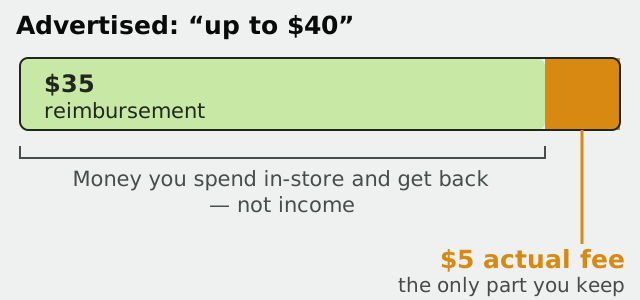
The mystery shopping row needs a caveat that never appears in the listing. Much of the headline figure is reimbursement rather than fee — you buy the meal, you are repaid for the meal, and the payment for your time is the smaller number underneath. Travel is unpaid on top of that. What the work actually pays once travel is counted works it through.
Batching, which is the whole technique
If the weekend's advantage is paying a setup cost once, the technique follows directly: group work by what it sets up.
Group by rig, not by client
Everything needing the camera out happens in one session, regardless of which brief each clip belongs to. Same for anything needing a quiet room, or a specific location.
Front-load the fixed cost
Do the setup-heavy work first, while you are fresh. Editing and admin survive being done tired; filming and client work do not.
Leave the fragments for weeknights
Editing, applications, admin, small tasks. These are genuinely fine in short blocks and they should not consume a long one.
Finish something
A weekend that ends with a deliverable sent is worth more than one that ends with three things half-done, both financially and in whether you do it again next week.
Local work, which the weekend makes possible
Worth its own section, because it is the category most completely closed off during the week and the one most often overlooked as a result.
Mystery shopping, product checks in shops, event work, in-person research, merchandising audits. All of it requires being somewhere at a particular time, which a weeknight after work rarely permits and a Saturday morning easily does.
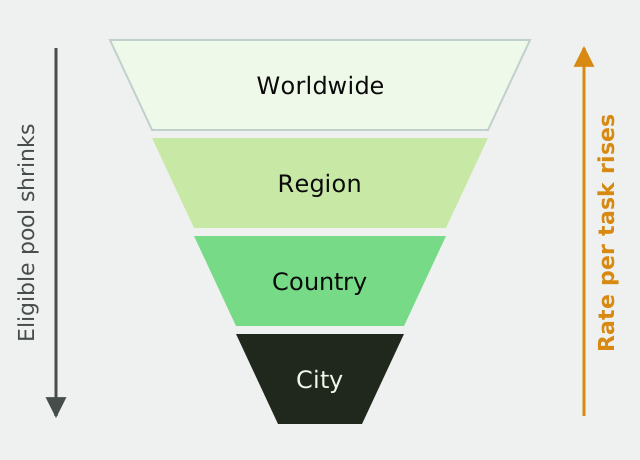
The pay is frequently better than the online equivalent for a straightforward reason: the eligible pool is everyone within driving distance rather than everyone with a laptop and an internet connection. Scarcity sets the rate here as it does everywhere else.
Two things to check before accepting any of it. Whether the figure quoted is a fee or includes reimbursement, since those are very different numbers. And what the travel actually costs in time and fuel, which never appears in the listing and frequently decides whether the assignment was worth taking.
The technique that makes this work is routing. Four assignments accepted separately means four journeys; the same four grouped into one Saturday morning circuit means one. Anybody doing this regularly plans the route before accepting the jobs rather than after.
The cost, which is real
Weekend work competes with recovery, and the bill arrives later than the evening equivalent.
Working both days, every weekend, produces a specific pattern: it feels sustainable for six to eight weeks and then stops abruptly. People describe it as losing motivation. What has usually happened is that they have not had a full day off in two months.
There is a household dimension too, and it is worth naming because it ends more side incomes than any platform decision does. Weekend hours are the ones other people expect you to be available for. Agreeing which day is which, in advance, avoids the version where the work happens in stolen fragments and is resented by everyone including you.
Making the two fit together
Evenings and weekends suit different work, and the strongest arrangement uses each for what it is good at rather than doing the same thing in both.
The pattern that works for most people: the weekend carries the setup-heavy, high-value work — filming, project work, local assignments — and weeknights carry the fragments that come out of it, plus the task work that fills gaps. What actually fits around a day job on a weeknight covers that side and why the two-hour block rules out more than it looks like it should.
The weekend decides what you earn. The evenings decide whether it gets finished.
Two things are worth checking before committing a weekend to any of this. First, your employment contract, since many require disclosure of outside work and some prohibit anything competing with the employer — the consequences fall on the job you already have. Second, whether the platform funds work before you start it, because a Saturday is a substantial thing to spend on a buyer who might not be there on Monday.
Getting a weekend started
The first two or three are worse than the ones after, and knowing why makes them easier to get through.
The setup cost that makes a weekend valuable also has to be paid the first time, before there is anything to show for it. Building a filming setup, learning a platform's requirements, assembling samples, working out a local route. None of that earns anything, all of it is a prerequisite, and it lands entirely in the first weekend.
Weekend one
Setup only. Profiles completed in full, equipment arranged, requirements read. Expect to earn nothing and plan for it rather than being discouraged by it.
Weekend two
One small complete thing, taken all the way through to payment landing in your own account. The size does not matter; finishing does.
Weekend three
Batch properly for the first time, now that you know what the setup involves. This is usually the first weekend that feels worth the day.
Weekend four
Work out the real hourly, counting setup and travel. Drop whatever came bottom and give that time to whatever came top.
Anyone who judges the whole idea on the first weekend is judging it at its single worst point, which is a shame, because the third one is generally when the arithmetic starts working.
Where the ceiling is
Weekend work has a harder limit than evening work, and it is worth seeing early. There are eight or nine weekend days in a month and you should be using four or five of them. That caps the hours at somewhere around 40, and no amount of organisation moves it.
So the only variable that matters over any real time horizon is the rate. A weekend at $15 an hour and a weekend at $60 an hour cost you exactly the same weekend.
That is the argument for spending the first few months acquiring something that narrows the pool — a portfolio, a specialism, a language, a repeat client — rather than optimising how many tasks fit into a Saturday. Which options have a rate curve and which do not sets them against each other with the honest hourly for each, and for work that pays for who you are rather than what you can do, what a second language is worth is the shortest route most people have available.