Search for online jobs with no experience and most results are job boards full of roles that quietly do require experience, mixed with listings written specifically to sell to people who have none.
The genuinely open routes are a short list. Here they are, with what each pays and how long before money arrives. Beginner-friendly categories include paid app testing, product testing and simple creator tasks; people comfortable on camera can move into UGC work without a large following. For the version organised by your constraints rather than by route, see how to pick a side hustle.
A job, freelance work and paid tasks are not the same offer
Search results use all three interchangeably. The distinction matters because only one promises employment.
| Route | What you are joining | How work arrives | What is not guaranteed |
|---|---|---|---|
| Remote employment | An employer with a role and schedule | Application, interview and hiring decision | Getting hired |
| Freelance work | Independent client contracts | Proposals, portfolio and repeat clients | The next contract |
| Paid tasks and testing | A marketplace or participant panel | Eligible tasks or invitations when buyers publish them | Task volume or regular hours |
RentHuman is in the third row. It is a marketplace for funded digital tasks, not an employer or staffing agency. You choose the worker path, complete the matching fields, reserve an available spot and submit the stated proof. Availability depends on live campaigns and whether your country, language, device and capabilities match. That can be useful variable income, but it is not a job offer and should not be budgeted as guaranteed pay.
“No experience required” describes the entry requirement. It does not describe the employment relationship, the amount of available work or the income you will receive.
What actually accepts beginners
| Route | Pays | First payment | What replaces experience |
|---|---|---|---|
| Paid task work | $10 – $30/hr | 1 – 7 days | A completed profile |
| App and website testing | $15 – $60/hr | 1 – 2 weeks | Owning a device |
| Product and research panels | $10 – $60/session | 1 – 3 weeks | Matching a demographic |
| Content production for brands | $40 – $150/hr | 4 – 8 weeks | Four self-made samples |
| Transcription, entry level | $12 – $25/hr | 1 – 3 weeks | Passing a test |
| Freelance from a work skill | $25 – $80/hr | 2 – 6 weeks | Your existing job |
Where those listings actually appear, and what each source pays, is covered in where side hustle jobs get posted.
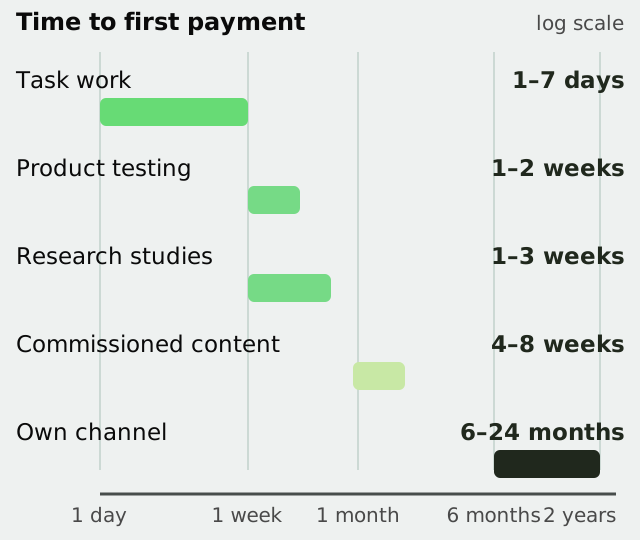
The three that start fastest
Paid task work. Micro jobs online are small, specific, verifiable jobs — testing a signup flow, giving structured feedback on a design, checking how something renders in your country, filming a short clip. No portfolio, no interview, no client relationship. You complete the task, submit the proof the brief asked for, and get paid on approval.
This is the fastest route from nothing to a first payment anywhere on the list, and the trade is that it does not compound. Finishing one leaves you where you started for the next.
App and website testing. Recording yourself using something and speaking your thoughts aloud. What qualifies you is owning a device and being able to describe what you noticed clearly. Old hardware is an advantage here, because coverage of the devices real users have is exactly the problem being solved. Product testing work runs on the same logic with physical goods.
Research and product panels. Companies pay for feedback from people matching a demographic. Selection is about matching a profile rather than about credentials, which is why completing the profile fields properly matters more than anything you could write about yourself.
The one with the highest ceiling
Content production for brands pays several times the others and takes a month or two to start, because you need something to show.
The barrier is lower than it looks. Brands buying short-form video want footage that looks like a real person filmed it, so a phone and daylight exceed the technical requirement. What they need to see first is four sample clips, which you make yourself with products you already own and label honestly as spec work.
That takes a weekend. The seven-day version covers what to film and where to send it. Then four to eight weeks of applying before a first booking, which is the actual cost of this route and the reason most people abandon it in week three.
Worth starting if you can tolerate a month with no income. Not worth starting if you need money in ten days, in which case run task work alongside it. Where the target is an urgent fixed amount, how to make $500 fast sets out the realistic timeline.
What makes a beginner get picked
Selection at this level is not about quality. Nobody has seen your work yet. It is about signals that you will complete what you took on.
A completed profile. Country, languages, devices, availability. Eligibility matching runs on structured fields, and an empty field reads as a disqualification rather than as a maybe. This is the single most common reason people see very little work available and conclude the platform is dead.
Answering the stated requirements explicitly. If a brief asks for someone in Germany who can deliver in 48 hours, confirm both in the first line. Reviewers filter on requirements before reading anything else, so most rejections happen before anyone forms an opinion.
Applying early. Most briefs are filled from the first hours of applicants. One posted three days ago with sixty responses is worth less of your time than one posted this morning.
Delivering on time, once. After a single clean delivery you are no longer a beginner in any way that matters to the next buyer.
For the version of this organised by how soon you need money rather than by route, see how to make money from home.
What to avoid, and why it targets you specifically
People searching for work with no experience are the easiest group in this market to sell to, and the listings know it. Two categories that sound like easy money and mostly are not: paid-to-scroll apps and paid-to-watch offers.
Pay described, work not described. "Earn $500 a week from home, no experience needed" with no statement of the task. Real listings describe the job because they need somebody able to do it.
Unpaid "trial tasks" of real length. A short sample is reasonable. Three hours of work described as an assessment is unpaid labour, and it is offered disproportionately to people who cannot yet tell the difference.
Anything arriving by direct message after you posted asking for help. Legitimate work is not sourced by messaging strangers who have just said they need money.
The wider question of which small-task platforms hold up is worked through in whether microtask sites are legitimate.
A first fortnight that produces something
Days 1–2
Register on two task or testing platforms. Complete every profile field, including country, languages and the devices you own. Expect no income.
Days 3–7
Take small tasks. Push one all the way through to a withdrawal in your own account, even for a few pounds. Completing that loop once teaches you more about a platform than any review, and you learn it while the balance is too small to matter.
Days 8–10
Volume, now that the process is familiar. Apply to everything you are eligible for in one category rather than scattering across several.
Days 11–14
If you want the higher-ceiling route, film four spec clips this week. If you have a work skill worth selling, send ten short messages to small businesses in that area instead.
Fifty to two hundred dollars in the first month is normal and is not a signal to stop. The second month is usually double, because the setup cost is paid once and not paid again.
What counts as experience, reconsidered
The phrase "no experience" hides a category error that costs people money for months.
Most people searching it have five or ten years of doing things somebody pays for. What they lack is a freelance track record, which is a different and much smaller gap. Those are not the same, and treating them as the same is why capable people spend a year on $8 tasks.
Run the inventory honestly. If you have held any job at all, some subset of these is true: you have coordinated between people who were not talking to each other, kept a system or a record accurate, handled somebody who was upset, prepared something for a deadline, explained a process to a new person, chased suppliers or customers, or worked inside a piece of software most people find confusing.
Every item on that list is billable. Bookkeeping preparation, inbox management, customer support, documentation, platform administration and coordination all pay two to four times what entry-level online task work pays, and the qualification is that you have already done it in an office.
What you actually need is evidence, and evidence is cheaper than experience.
Three short spec pieces, or two completed tasks with a clean record, or a single former colleague willing to say you did the thing. Any of those closes the gap in a fortnight. Entry-level transcription is another way to produce a clean record quickly, since the qualification is a test rather than a history.
Two mistakes that cost the most time
Applying without a completed profile
It sounds trivial and it is the largest single cause of people concluding a platform has no work. Eligibility matching runs on country, language and device fields. Leave them blank and you are filtered out of the briefs you would have won, silently, with nothing telling you it happened.
Scattering across categories
Ten applications spread across six unrelated types of work performs worse than ten in one, because nothing accumulates. A reviewer looking at a profile with two approved tasks in their category treats you differently from one with two approved tasks in six categories.
Pick one thing. Give it a fortnight of actual volume rather than three tentative applications. Then judge it on the effective hourly rate you measured, not on how it felt.
Measuring whether it is working
Two weeks in, work out the effective hourly rate rather than the total. Count everything: finding work, reading briefs, applications that went nowhere, the task itself, and the wait for approval. Divide the money by all of it.
That number is usually a shock, and it is the most useful thing you will produce in the first month. It tells you which of the things you tried to drop, which is a decision nobody can make for you from the outside.
Then judge it against the right benchmark. Not against what an article promised, and not against somebody's screenshot. Against what the same hours would earn you elsewhere, and against what the number was last week.
Moving off the beginner tier
The trap is staying on entry-level task work because it is comfortable and pays immediately. It has no rate curve — month twelve pays what month one paid.
Two ways out, and only one of them scales. Adding hours has a ceiling at the number of evenings you have. Raising what an hour is worth does not, and it happens through specialising: one category, one skill, or one language or market where the eligible pool is small.
That is the whole difference between a side income that stays at $150 a month and one that reaches four figures. Which options have a rate curve and which stay flat sets them out against each other.
One route worth singling out is software testing, which takes beginners, pays on a per-report basis and needs nothing but a phone you already own — what app testing work involves covers the way in.