Most advice about working from home in the evening is the same advice about working from home, with the word evening added. The constraint that actually matters gets skipped entirely. The wider set of routes, sorted by constraint rather than by type, is in how to choose a side hustle.
You are tired. The block is short and it ends. Some nights it does not happen at all. Any route that ignores those three facts will be abandoned in a month, regardless of what it pays on paper.
What the evening rules out
Worth doing first, because eliminating is faster than choosing.
Live scheduled commitments are the main casualty. Moderated research sessions, tutoring slots with a fixed time, real-time support cover, anything where somebody is waiting. Not because they pay badly — several pay very well — but because a day job produces late finishes, and missing a booked slot damages the thing that matters most in every one of these routes.
Then anything needing deep sustained concentration. Complex writing, detailed analysis, work with a long mental warm-up. It is not that you cannot do it at nine at night; it is that you will do it worse and slower than you would at ten in the morning, and the hourly rate you calculate afterwards will reflect that.
And finally, anything requiring you to be somewhere. The weekend can absorb that; a Tuesday night generally cannot.
What survives
The routes that work share one property: they are asynchronous with a real deadline. Somebody needs it by Thursday, and which hours you use is your business.
Task and testing work
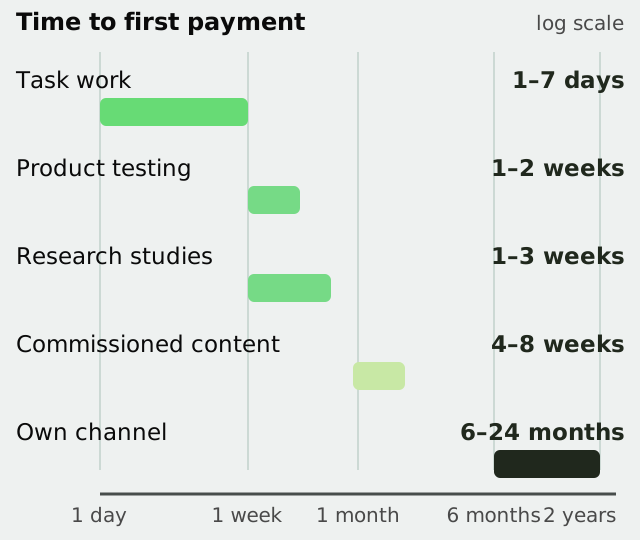
Small, self-contained jobs finished in one sitting — testing a signup flow, recording a short usability session, checking how a page renders in your country, giving structured feedback. Fifteen to forty minutes each, no continuity between them, and you can stop whenever the evening ends.
The strongest fit for unpredictable nights, because nothing is half-finished when you close the laptop.
Content and creator work
Filming, editing, writing to a brief. Deadlines run in days rather than hours, so a lost Tuesday is absorbed by Wednesday. Evening light is poor for filming, which is a genuine constraint people discover late — most creators shoot at the weekend and edit on weeknights.
Freelance work in your day-job skill
The best-paid option available to most people and the most consistently overlooked, because it does not feel like a side hustle. Bookkeeping, design, copywriting, development, translation, admin. Deadlines rather than hours, which suits evenings well — provided you decline anything needing daytime calls.
Transcription and translation
Mechanical enough to do while tired, granular enough to stop mid-file, and paid per unit rather than per session. Translation pays several times what transcription does for the same hour, and non-English pairs are short of people almost everywhere.
Tutoring deserves a mention as the exception that proves the rule. It has fixed live slots, which the evening usually rules out — except that your evening is somebody else's morning. Tutoring students in a time zone six to nine hours ahead turns the constraint into an advantage.
What two hours a night is worth
Arithmetic first, because the monthly figure surprises people in both directions.
Two hours a night, four nights a week, is about 35 hours a month. That is the number to price against, and it is meaningfully less than the "ten hours a week" people plan for and considerably more than nothing.
| Route | Hourly | Monthly at 35h |
|---|---|---|
| Task and testing work | $12 – $30 | $420 – $1,050 |
| Transcription | $12 – $25 | $420 – $875 |
| Content production | $20 – $60 | $700 – $2,100 |
| Translation | $25 – $90 | $875 – $3,150 |
| Freelance day-job skill | $25 – $80 | $875 – $2,800 |
The bottom two rows are where the money is, and both are available to more people than attempt them. "No experience" almost always means no freelance experience, which is a much smaller gap than having no sellable skill.
Anybody who has held a job has been doing billable work for years without describing it that way.
The first hour is the expensive one
Something specific to short blocks: the setup cost is paid every single night.
Opening the laptop, finding where you were, remembering the brief, getting into it. On a full working day that overhead is amortised across eight hours. In a two-hour block it can be a quarter of the session, which is why people conclude that evening work "isn't worth it" when what is actually happening is that they are paying the same startup cost four times a week.
Decide the night before
Not what you will work on in general — the specific task. Deciding at 9pm costs twenty minutes and the decision is worse.
Keep one thing open
Working across three platforms in a two-hour block means three sets of context. One at a time, for a week at a time.
Batch the similar
Four testing sessions in one evening is faster than one on each of four nights, because you pay the warm-up once.
Stop on time
The two-hour block is a limit, not a target to exceed on good nights. Overrunning is what makes the next three nights not happen.
Matching the work to how tired you are
Not every evening is the same, and the people who get the most out of the pattern sort the work rather than pushing through it.
A good evening — finished on time, nothing draining during the day — takes the work that needs judgment. Client work, writing, anything where the output is assessed rather than counted.
A bad evening takes the mechanical work. Transcription, tagging, editing, admin, applications. It still pays, it still counts toward the month, and doing it badly is much harder than doing judgment work badly.
The alternative — deciding at 9pm that tonight is not the night — is how the whole thing quietly stops. There is nearly always something you can still do; the question is whether you decided in advance what it was.
The day job, which comes first
Two practical matters that people handle late and should handle first.
Read your employment contract. A great many require disclosure of outside work, and some prohibit anything that competes with the employer or uses their equipment. This is not a formality — the consequences land on the income you already depend on, not on the side income you are building.
The second is sleep, and it is the one that decides whether this lasts. Evening work competes with rest rather than with leisure, and the cost shows up in daytime performance two to three weeks later, by which point the connection is easy to miss. People who sustain this protect a fixed bedtime and treat the four-night pattern as a ceiling rather than a starting point.
What the first month looks like
Realistically, and it is less encouraging than most accounts.
Week one
Set up on one or two platforms and complete every profile field — country, languages, devices, sector. Matching runs on those fields and a blank one silently removes you from work you would have won. Expect to earn nothing.
Week two
Take small jobs and push one all the way through to a withdrawal into your own account, even for a few pounds. Completing that loop once tells you more than any review.
Week three
Volume, now the process is familiar. Apply to everything you are eligible for within one category rather than scattering across four.
Week four
Work out what you actually earned per hour, counting the setup time. Drop the weakest source and give those nights to the strongest.
$50 to $250 in the first month is normal and is not a reason to stop. The second month is usually double, because the setup cost is paid once rather than repeatedly.
The thing that decides whether it is still worth it in a year
Most evening routes have no rate curve. Basic task work pays the same in month twelve as in month one, however good you become at it, and the only way to earn more is to work more nights — which runs into a hard ceiling at the number of evenings you actually own.
The routes that climb do so because you become harder to replace: a specialism, a language, a portfolio, a client who comes back. That is the entire difference between an evening income that sits at $200 a month indefinitely and one that reaches four figures.
Adding nights has a ceiling you will hit within weeks. Raising what a night is worth does not.
Which points at an uncomfortable but useful conclusion. If you have a professional skill, a second language, or deep knowledge of an unglamorous field, the evening is better spent selling that at $40 an hour than doing task work at $15 — even though the task work starts paying sooner and the skilled route takes a few weeks to produce anything.
The comparison of what each option pays per hour is worked through in what home side hustles actually pay, and if you are choosing a starting point rather than comparing options, the three questions that narrow it is the faster route in. For longer blocks and the work that needs them, what the weekend suits is a different set of answers. Nearly all of this is contractor work rather than employment, so what that costs in tax and protections is worth reading before it becomes a meaningful share of your income.