Reddit is the only large source on this subject that is not funded by the thing it recommends. No affiliate commissions on most of it, no sponsored placements, and a voting system that punishes the obviously self-interested. That makes it more honest than nearly every published list.
It is also heavily survivor-biased, occasionally overconfident, and full of people describing month three of something as though it were year two. Knowing which of those is operating in a given thread is the whole skill.
Where the useful discussion is
r/beermoney. Small online earning — task sites, testing, surveys, offers. The most rate-honest community on this list, because members track hourly earnings obsessively and post when something drops. Read it for what a platform actually pays this month rather than what its marketing says.
r/WorkOnline. Broader remote work, higher earnings, more transcription and writing. Better signal-to-noise than the bigger subs and more willing to say a route is not worth it.
r/freelance. Client work, pricing, contracts, difficult clients. The most professionally useful of them if you sell a skill, and the least interested in the word "hustle".
r/Flipping. Reselling. Genuinely expert, genuinely niche, and the single best example of survivor bias on the platform — post-worthy finds get posted and dead stock does not.
r/juststart. Content sites and long-horizon projects. Realistic about timelines in a way most content advice is not.
r/sidehustle. The biggest, and mostly a discovery feed. Good for finding out what exists, unreliable for judging it, because volume attracts promotion.
The recurring consensus
Read enough of these and the same advice surfaces repeatedly. Sorted by how well it holds up:
"Sell a skill you already have." The most repeated and the most correct. Consistently the highest-paid route, consistently the one people skip because it requires contacting strangers.
"Everything takes longer than the post said." Also correct, and usually stated by someone six months into something. The gap between a launch post and a results post is where most expectations break.
"Track your effective hourly rate." Including unpaid time — applications, screen-outs, admin, waiting. This single habit does more to improve someone's side income than any platform recommendation, because it reveals what to stop doing.
"Surveys are not worth it." Broadly right. Effective rates land in the low single digits once screen-outs are counted, and screen-outs are unpaid.
"Do one thing for at least a month." Correct, and universally ignored. Running four things simultaneously means paying four setup costs and finishing none.
"Don't pay to work." The one piece of advice with no exceptions.
Where the consensus is weaker
Reselling is over-represented. r/Flipping is full of people who found something valuable, and empty of people whose garage is full of unsold stock. The winners post. The skill is real and the returns are far more variable than the feed implies.
Content and affiliate timelines are understated. Threads describing traffic at month nine get upvoted; the far larger number of abandoned projects generate no posts at all. Plan on a year, not a quarter.
"Just start a YouTube channel" persists despite the median outcome being nothing. It is a legitimate long-horizon project and a terrible answer to "I need money by March".
Regional advice gets universalised. Something that pays well in the US may not be available where you are, and the reply telling you so tends to arrive three days later with four upvotes.
Anything current is under-discussed. By the time a route has a well-upvoted thread it has attracted enough people to compress the rate. The best-paying things are usually being discussed quietly rather than at the top of the sub.
How to actually use it
Sort by new, not by top
Top posts are the survivor stories. New posts include the person asking why their first month produced nothing, and the replies to that are where the honest information is.
Search before posting
Every general question has been asked hundreds of times, and the archived answers are better than what a new thread will attract.
Read the negative threads deliberately
Search a platform name plus "not worth" or "quit". The complaints describe mechanisms — how rejection works, what the withdrawal threshold is, whether support responds — and mechanisms are checkable facts rather than opinions.
Ask specific questions
"How do I make money online" produces nothing. "I have six hours a week, I can write technical documentation, and I need a first payment within a month" produces genuinely good answers, because it is answerable.
Check the account
Enthusiastic recommendations from accounts created recently, with no history in the community, are advertising. This is the single fastest filter available.
Treat any referral link as a paid endorsement
Not necessarily dishonest, and not disinterested either.
Why the rate-tracking culture matters
One habit in these communities is worth adopting whatever you end up doing, and it is the reason r/beermoney is more useful than its subject matter suggests.
Members there report earnings as an hourly figure including unpaid time, not as a total. A post saying "made $40 this week" is routinely met with "over how many hours, including waiting and screen-outs?" and the answer frequently turns $40 into $3 an hour.
That norm exists nowhere else in this subject. Published articles quote advertised rates. Platforms quote best cases. Only a community of people grinding small tasks has the incentive to work out what an hour is actually worth, and to say so when a platform's rate quietly drops.
Adopt it for yourself. Log the time from opening a platform to money confirmed — how a platform's payouts are structured is part of that clock, not a detail after it — rather than only the time spent on the task. Most people discover one of the things they are doing pays a third of what they assumed, and dropping it is the single largest improvement available.
The scam patterns specific to Reddit
The communities are mostly well-moderated. The direct messages are not.
"I made $X, DM me for the method." The method is the thing being sold.
Fake job posts routing to an application that harvests documents. Verify the company independently rather than through the link provided.
Buy-and-refund review schemes, advertised as product testing. You pay, post a review, and the refund may or may not arrive. Why that structure is the way it is covers what actually happens when these go wrong.
Upvoted comment recommendations from vote-manipulated threads. A comment's score is weaker evidence than the account's history in that community.
If it arrives in your inbox rather than being something you went looking for, it is being sold to you.
What the honest threads say about earnings
Strip out the outlier posts and the numbers people report cluster tightly.
The same test, applied to platforms rather than messages, is the check for whether a microtask site is legitimate.
Above that range, almost everyone reporting real numbers is doing client work or running a product, which is nearer to freelancing than to a hustle.
Nobody credible reports meaningful passive income inside six months. The threads claiming otherwise are usually selling a course, and the comments underneath usually point that out.
That range is roughly what the wider comparison of what home side hustles pay arrives at from a different direction, which is a reasonable sign both are approximately right.
Contributing rather than only reading
The people who get the most out of these communities are the ones who post results rather than questions, and it pays back in a way that is not obvious.
Post what you actually earned, including the failures. A thread saying "I tried this for six weeks, here is the hourly rate including unpaid time, here is why I stopped" gets more genuinely useful replies than any question, because people who know the space arrive to correct or extend it. Being corrected by somebody experienced is worth more than an upvote.
It also builds the account history that makes your own questions get answered later. Communities respond to people who have contributed and ignore accounts that only ever ask.
Worth posting
Results, with the hours and the unpaid time attached, and the reason you stopped.
Not worth posting
Referral links, unless the sub explicitly permits them, and even then expect a cold response. Earnings screenshots as a flex attract the direct messages described above and add nothing a stated hourly rate does not.
The advice that generalises
Strip out the platform-specific detail and Reddit's collective position on side income comes down to about six things, all of which hold up.
Sell something you already know how to do, because the alternative is spending months acquiring a skill before earning anything. Pick one thing and stay with it for a month, because setup costs are paid once and running four things means paying four of them. Count your unpaid time, because the advertised rate and the real rate diverge by more than most people expect. Do not pay to work. Expect the first month to produce very little and the second to produce roughly double, because the setup was the expensive part. And treat anything promising passive income inside six months as a sales pitch.
None of that is novel and all of it is right, which is a reasonable description of the best thing about the source. It is not clever. It is just less compromised than the alternatives, and reading it with the survivor bias in mind gets you most of the way to a sensible plan.
Reading a platform thread properly
When a specific platform comes up, the useful questions are always the same, and the good threads answer them.
What is the effective hourly rate, counting unpaid time? How long until the first withdrawal actually landed? What happens when work is rejected — is there any explanation, or a route to appeal? What is the minimum withdrawal, and how long does that take to reach? Is the good work gated behind a volume of low-paid work first?
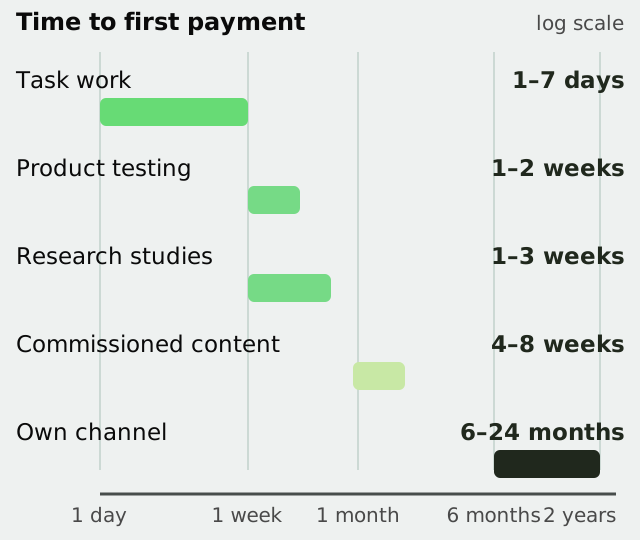
A thread answering those is worth more than fifty upvotes on a thread that says "this one is great". Where the answers are absent, they can usually be checked directly against the platform's own terms, which takes ten minutes and beats any amount of reading.