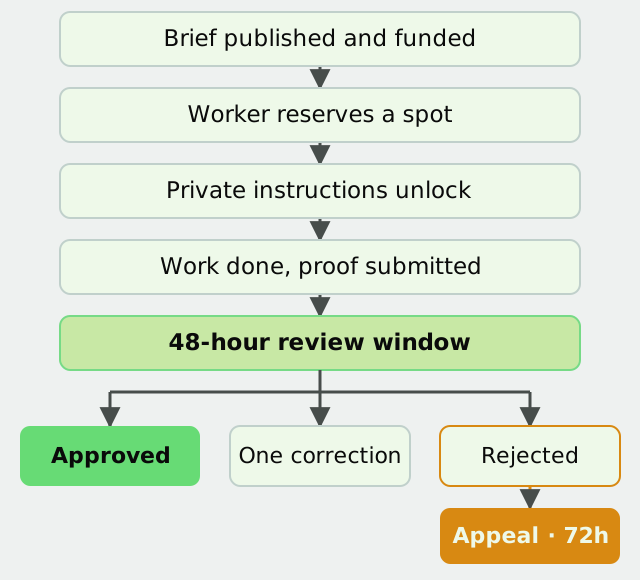
Mystery shopping is a business paying somebody to be an anonymous customer and report what happened.
That is the whole mechanism, and the reason it exists is more interesting than the definition. A company with two hundred locations can see sales, staffing and complaint volumes for every one of them. What it cannot see is the thing that produces all three: what actually happens when a person walks in.
Why the obvious alternatives do not work
Managers observing their own sites. Staff behave differently when the manager is watching, and a manager reporting on their own location has an interest in the result. Both problems are unavoidable.
Customer surveys. Response is voluntary, which selects for the very pleased and the very angry. The large middle — people who found it fine, or mildly annoying, and left — never responds, and that group is where most revenue lives.
Complaints. A record of failures severe enough that somebody bothered to report them. Silence about everything short of that.
Sales data. Tells you a location underperforms. Cannot tell you whether the cause is queue length, an unhelpful assistant, a broken payment terminal, or the car park.
Cameras. Show what happened and not what was said, and staff behave differently on camera in ways that recur.
Mystery shopping is the only method that observes ordinary service, from the customer's position, against a checklist that makes one site comparable to another.
That is a narrow capability, and it is hard to get any other way.
How the industry is structured
Three parties, in the order the money moves through them.
The client
A retailer, bank, restaurant group, dealership network or public body. They decide what to measure and pay for the programme.
The mystery shopping company
Designs the questionnaire, recruits and vets shoppers, schedules visits, validates reports and delivers analysis. This is where most of the money goes, and most of the work.
The shopper
An ordinary person completing individual assignments. Paid a fee per visit plus reimbursement for any required purchase. Not an employee of anyone, and typically doing it as occasional supplementary income.
What gets measured
The useful programmes measure things that produce numbers rather than adjectives.
The company between the two exists for a real reason: a client cannot recruit anonymous customers itself without the anonymity collapsing, and it cannot standardise across hundreds of visits without a methodology. What that costs and when a client can skip it is a separate question.
- Timings. Seconds to acknowledgement, minutes queuing, time to resolution.
- Compliance with a process. Was the upsell offered, was the loyalty scheme mentioned, was the safety question asked.
- Physical state. Stock levels, cleanliness, whether the promotional display is up, whether pricing matches the system.
- Accuracy. Did the person give correct information about a product, a policy, a rate.
- Scripted probes. A specific question asked in the same words at every site, with the response recorded verbatim, usually alongside evidence that can be checked later.
What good programmes avoid is asking whether service was "good", because the answer varies with the shopper rather than with the site and cannot be aggregated across two hundred visits.
Where the reports go
This is the part that decides whether a programme is worth running, and it is where most of them fail.
Well run
A named owner, a threshold that triggers action, and a route from a finding to somebody with authority to change something. A site scoring below a defined level generates a specific intervention rather than a conversation.
Badly run
Accurate reports that circulate as a monthly attachment. The measurement is fine. Nothing downstream exists, and after a year the programme is cancelled as ineffective — which it was, though not for the reason usually given.
Before any organisation commissions this, the question worth answering is: what decision will this change? If the honest answer is none, the programme is an expense whatever it costs.
The ethical dimension
Mystery shopping observes people at work without telling them which interaction is being assessed, and that deserves more than a shrug.
The practices that make it defensible are reasonably settled. Programmes evaluate processes rather than individuals, and reports avoid naming staff where possible. Employers disclose that a programme exists even though individual visits are unannounced, so nobody is being secretly recorded without knowing the practice happens at all. Scenarios stay within ordinary customer behaviour rather than requiring elaborate deception or entrapment. And findings feed training rather than discipline, because a programme used to fire people produces staff who optimise for spotting the shopper.
Where those conditions hold it is a reasonable measurement practice.
What it costs to run
Full-service programmes are typically priced per completed visit, commonly $40 to $150 depending on complexity — a fast-food visit sits at the bottom, a car dealership or hotel evaluation at the top. That covers recruitment, design, validation and analysis, with the shopper receiving a fraction of it.
The shopper's fee is $8 to $30 for most retail and hospitality assignments, rising to $100 or more for specialist visits. What that looks like from the shopper's side covers the fee-versus-reimbursement distinction that catches people out.
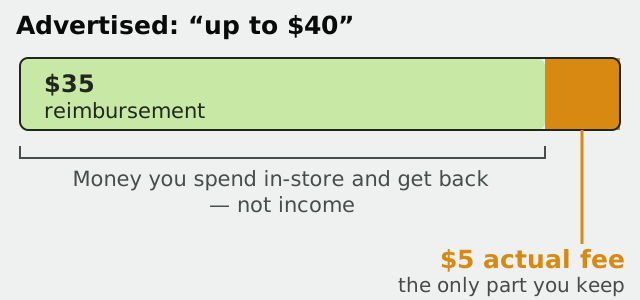
Full service is not the only way to buy an observation.
Where the model is weak
Small samples say very little. One visit per site per quarter measures one shift, four times a year. Distinguishing a systemic problem from a bad Tuesday needs several visits, and budget usually cuts frequency before it cuts site count, which is the wrong order.
Shoppers get recognised. Send the same person to the same location repeatedly and you measure how staff treat that person.
It captures a moment. A visit at 11am on a Wednesday tells you nothing about Saturday afternoon, which is when the queue actually forms.
Scripts can distort. A scenario requiring unusual behaviour produces an unusual response, and you have measured the scenario rather than the service.
It cannot explain causes. Knowing that greeting time is ninety seconds does not tell you whether the cause is understaffing, a rota problem, or a till system that traps people at the counter.
None of those make it useless. They mean it is one instrument among several, best read alongside sales, staffing and complaint data rather than instead of them.
A short history, and why it grew
The practice predates the internet by a long way. Banks and retailers used anonymous evaluators through most of the twentieth century, originally to check for theft by staff rather than to measure service. The shift from loss prevention to customer experience happened gradually as chains grew large enough that head office had no direct sight of what any individual branch was like.
Two things changed it more recently.
Online review platforms gave companies a flood of public feedback and made the limitations of that feedback obvious. Reviews are voluntary, emotionally skewed, and impossible to compare between sites because each has a different customer base. Controlled observation solved a problem public reviews created rather than being replaced by them.
Smartphones removed most of the cost. A shopper with a phone can photograph a shelf, timestamp an interaction and file a report from the car park, where previously the same assignment meant a paper form posted back. That collapsed the cost per visit and expanded what could be measured — photographic evidence became routine rather than exceptional.
The next shift is already visible in how the work is bought. Where a question is purely factual, clients increasingly commission the observation directly as a task rather than as a programme, because the analysis layer they were paying for is not needed to answer whether a display is up.
Variants of the same method
The term covers several practices that differ more than people expect.
In-store evaluation. The classic version. A visit against a checklist.
Telephone and web evaluation. Calling a contact centre or using a chat channel with a scripted enquiry. No travel, lower fee, and often the most revealing, because contact centres are where policy meets reality.
Purchase and return. Buying something and then returning it, to measure the part of the journey nobody designs.
Competitor benchmarking. The same evaluation run on a competitor's sites, for comparison. Legal and common, and it is why your local branch is occasionally evaluated by somebody working for someone else.
Compliance checking. Age verification, regulated advice, safety procedure. Higher stakes, better paid, and usually run by specialists because the finding may be contested.
Digital-only evaluation. Checking a website, an app or a delivery experience rather than a physical place. This is the version with no geographic limit beyond where the evaluator's account and address happen to be.
The general principle
Strip out the retail context and mystery shopping is an instance of something broader: paying an ordinary person to observe something specific and report it against a fixed standard, because no system or insider can see it from where they sit.
The same logic covers checking whether a website renders correctly for somebody actually located in Brazil, whether an app's signup works on a three-year-old phone on a congested network, or whether a listing shows the price it is supposed to in a market you do not operate from.
All of it is the same purchase — a structured observation from a person in a place — and the design questions are identical. Ask something with a checkable answer, require evidence alongside it, sample enough times to see a pattern, and make sure somebody reads the result.