Gig work is short, discrete paid work taken as an independent contractor rather than as an employee. The work varies enormously; the classification is what the term is really about.
That classification decides your rate, your protections, your tax and your recourse when something goes wrong. Almost every argument about the gig economy is an argument about it.
The four categories
They are grouped together and they have very little in common beyond the contract type.
Driving and delivery
Rides, food, parcels, shopping. The most visible category and the one with the largest hidden cost, because fuel, insurance, maintenance and depreciation come out of the headline rate. Highly flexible, physically demanding, and the earnings figures quoted by platforms are almost always gross of vehicle costs.
Platform and task work
Small, discrete online jobs — testing, feedback, content, verification, data work. No vehicle, no travel, and the rate depends heavily on how scarce your eligibility is. What separates a reasonable platform from a bad one matters more here than the advertised rate.
Freelance services
A professional skill sold by the hour or the project — writing, design, development, bookkeeping, translation, administration. The best-paid category by a wide margin, and the one requiring you to find your own clients.
Creator and content work
Producing content for brands to use. Priced on the deliverable and the licence rather than on time. No audience required for the commissioned version, which surprises people. What that pays once usage rights are priced is a subject of its own.
What each pays
| Category | Hourly, honest | After costs |
|---|---|---|
| Delivery and rideshare | $15 – $25 | $8 – $16 |
| Platform task work | $10 – $30 | $10 – $30 |
| Research and testing | $15 – $60 | $15 – $60 |
| Creator and content | $40 – $150 | $35 – $140 |
| Skilled freelance | $25 – $80 | $25 – $80 |
The second column is why the categories are not comparable. Driving carries fuel, wear and insurance; online work generally carries nothing beyond a device you already own. A $20 delivery hour and a $20 task hour are not the same $20.
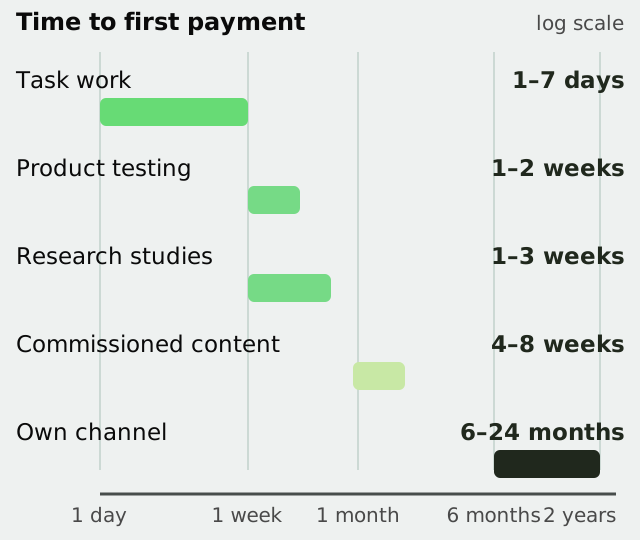
The trade nobody prices
An employer's cost of employing somebody is well above their wage. The gap covers holiday, sick pay, pension, employer taxes, equipment, training and the cost of paying them during quiet weeks.
Gig work removes that gap and hands you the wage side of it. Which is why the hourly looks good and the year frequently does not.
Gig work pays more per hour than the equivalent job and less per year. The difference is everything you are not being given.
What you take on when you take the higher rate:
Unpaid gaps
Employment pays you through a quiet Tuesday. Gig work does not, and utilisation is rarely the 100% the hourly rate implies.
Your own tax
Nothing is withheld. In most countries the liability starts at the first payment, not at a threshold.
No paid leave
Holiday and sickness are unpaid, so the effective annual rate is lower than the hourly suggests by roughly the proportion of the year you do not work.
Equipment and costs
Vehicle, phone, software, workspace. All yours.
No notice
An account can be deactivated, a client can stop, a platform can change its rates. None of it requires a notice period.
For work that is not tied to where you live at all, the remote options compared is the relevant filter. None of that makes gig work a bad choice. It makes the honest comparison "hourly rate minus 25 to 40 percent" against an employed hourly rate, rather than the two headline numbers side by side.
Classification, and why it keeps going to court
Whether somebody is genuinely an independent contractor or an employee in all but name is the central legal question in this area, and it is unresolved in most jurisdictions.
The tests differ by country but ask broadly similar things. Who controls how the work is done. Whether the worker can genuinely refuse jobs. Whether they can send a substitute. Whether they are economically dependent on one engager. Whether they can profit from their own efficiency.
The practical point for somebody deciding: if a platform controls your hours, your method and your pricing, and you cannot decline work without penalty, you may have more rights than the contract states. That is worth knowing before you need it.
What the flexibility is actually worth
The argument for gig work is control over when you work, and it is real. It is also less absolute than it sounds.
Platform work with surge or peak pricing is flexible in name and strongly incentivised in practice — you can work any hours you like, and the ones that pay are Friday night. Task and content work is genuinely flexible, because a brief with a 48-hour window does not care which hours you use. Freelance work is flexible at the day level and rigid at the deadline level.
The version of flexibility worth having is asynchronous work with a real deadline rather than a real-time demand curve. That distinction is a better predictor of whether somebody enjoys gig work than the rate is.
Insurance and the things nobody mentions
Three practical exposures that only surface when something goes wrong.
Ordinary car insurance frequently does not cover driving for hire or reward, and a claim during a delivery can be refused on that basis. If you drive commercially, the cover has to say so.
Home contents and public liability rarely extend to business use. Somebody working from home professionally, storing client property, or having anyone visit for work purposes is often outside the terms of a standard domestic policy.
And professional liability matters the moment your work could cause somebody a loss — bookkeeping, advice, anything regulated. Employment carries this implicitly; contracting does not.
None of these are large costs and all of them are invisible until a claim, which is exactly when finding out is worst.
Making it work financially
Track the real hourly
Include finding work, unpaid waiting, admin, travel and any costs. The number is always lower than the advertised rate and it is the only one worth acting on.
Set money aside for tax
A fixed share of every payment, from the first one, into an account you do not touch.
Do not depend on one platform
Rates change, accounts get deactivated, algorithms shift. Two or three sources is the difference between a bad month and no income.
Move up a category
Delivery and basic task work have no rate curve. Skilled freelance and content work do, and the gap between the bottom and top of this market is a factor of ten.
Keep your own records
What you did, for whom, when, and what arrived. Nobody else is keeping them for you.
How platforms actually set your rate
Worth understanding because it explains behaviour that otherwise looks arbitrary.
On most platforms the rate is not negotiated, it is offered, and the offer is generated from supply and demand in your area at that moment. When more people are available than there is work, the rate falls; when fewer, it rises. Nothing about your experience enters the calculation.
That has three consequences people discover the hard way.
Earnings are unpredictable in a way employment is not, because the same hours in the same week can pay differently. A good week is not a new baseline.
Volume works against you collectively. Every additional person available in your area at your times reduces what the platform needs to offer, which is why a route that paid well two years ago frequently does not now.
And working harder does not raise the rate. It raises your total, which feels the same until you calculate the hourly and find it unchanged.
The exception is anywhere eligibility is narrow. Work restricted by language, location, device or qualification has a small pool by construction, and the rate reflects that. Which is the entire argument for moving out of the general tier rather than working more hours in it.
The record-keeping that pays for itself
Nothing about contractor income is automatic, and the two habits that matter both take about ten minutes a week.
Track hours worked rather than jobs completed, including the unpaid ones — waiting, travelling between jobs, the applications that went nowhere. Without that number the effective hourly is unknowable, and the effective hourly is the only figure that answers whether any of this is worth doing.
Keep the expenses as they happen rather than reconstructing them in a panic later. Mileage, equipment, a share of phone and internet where the rules allow it, platform fees already deducted from your payments. On a year of part-time contractor income these routinely come to several hundred, and they are only claimable if somebody wrote them down.
Who it suits
Gig work is a good deal for people using it as a supplement to other income, for people whose circumstances genuinely require irregular hours, and for anyone in the skilled tier who can charge enough to self-fund the protections they gave up.
It is a worse deal than it looks for anybody relying on it as a full replacement for employment at the lower rates, because the hourly comparison is misleading by 25 to 40 percent before unpaid gaps are counted.
The honest test is whether your rate, minus your costs, minus your tax, across the hours you actually get, beats the alternative. That is a calculation nobody else will do for you, and the comparison of what each option pays per hour is the closest thing to a starting point.