"Product testing job" covers four different arrangements that pay in completely different ways, and most advice about it does not distinguish them. One pays cash, one pays in products, one pays nothing and wants your reach, and one is a review scheme with your money at risk.
Sorting them takes about a minute per offer once you know what to look for. For the version where products arrive at no cost, free product testing covers what those programmes actually ask of you.
The four types
Paid research and usability testing. A company pays you to use something and report back, usually with a screen recording or a structured questionnaire. Cash, $10 to $60 a session for unmoderated work, $40 to $150 an hour for moderated sessions with a researcher. This is the best-paid version and the least advertised, because the companies running it recruit through panels rather than through content.
Manufacturer and retailer panels. Large consumer-goods companies run their own testing programmes. You receive products, use them properly, and complete a detailed feedback form. Payment is the product, occasionally with a small incentive. Legitimate, unglamorous, and involves forms.
Task-based digital product tests. Smaller, more specific work: complete an app signup, test a checkout, record where a website becomes confusing, compare two landing-page messages or explain what a user in your country can see. Cash per task, with the reward and required proof stated before you start.
What each pays
| Type | Payment | Realistic monthly |
|---|---|---|
| Moderated user research | $40 – $150/hr | $50 – $400 |
| Unmoderated usability sessions | $10 – $60/session | $40 – $250 |
| Task-based digital tests | Reward set per task | Varies with live campaigns |
| Manufacturer panels | Products | Variable, no cash |
| Retailer review programmes | Products | Variable, no cash |
| Review schemes | Nothing, or a loss | Avoid |
The monthly figures are wide because volume, not rate, is the constraint. Companies test when they have something to test, and no amount of availability on your part changes their release schedule. Anyone treating this as a primary income is either doing something else as well or reporting a good month.
Is it a career?
Mostly not, in the sense the phrase implies.
Product testing as employment does exist — quality assurance, consumer insight and user research roles inside companies. Those are ordinary jobs, advertised on careers pages, requiring applications and usually relevant experience. If that is what you want, search for those titles rather than for "product testing careers", because the second phrase is mostly used by content farms.
What is advertised online as a product testing career is occasional paid participation. That is a legitimate thing to do and it is not a job, and the sites blurring the two are usually collecting your details for something else.
How selection actually works
Panels do not choose people who are enthusiastic. They choose people who match a demographic and usage profile a client asked for, which is why acceptance feels arbitrary.
Four things genuinely improve your odds.
Complete every profile field honestly
Household composition, products you already use, devices you own, brands you buy. This is the matching data, and a sparse profile matches nothing. Exaggerating to qualify for more gets you screened out mid-study and removed from the panel.
Respond fast
Studies fill in hours. A panel invitation answered the next morning is usually too late, and panels notice who responds.
Deliver on the deadline
The single largest factor in being invited again. Panels maintain reliability scores whether or not they show them.
Give specific feedback, not positive feedback
"I liked it" is worthless. "The lid was difficult to open with wet hands, and I stopped using it after the third day for that reason" is the thing being purchased. Critical testers get invited back; complimentary ones do not.
Telling real from fake
Five checks that separate the categories above.
Where does your output go? To the company, privately, or to a public review? Feedback delivered to a manufacturer is research. A required public review with a specified rating is not.
Is a rating specified in advance? Any mention of five stars, positive sentiment or a minimum score means the rating is the product being bought.
Do you pay first? Buy-and-refund is the defining structure of review fraud. Legitimate testing sends you the product or pays you directly, always.
Are you asked for money for access? Membership fees, starter kits, "premium tester" tiers. None of these exist in legitimate programmes.
Is compensation disclosed to any audience? If the arrangement depends on readers not knowing money or product changed hands, it is the thing regulators pursue. What happens when review schemes go wrong covers the specific consequences.
Where to find the real ones
Research and usability panels. Sign up to several rather than one, because eligibility is narrow and each screens differently. What focus groups, interviews and diary studies pay covers the better-paid end of the same market. Complete the device and demographic fields properly — device coverage in particular is what gets you invited to app testing. App tester jobs and professional QA roles are separate paths, and the focused guide explains which one a listing actually means.
Manufacturer programmes. Most large consumer-goods companies run one. They are found on the company's own site rather than through aggregators, and they are not heavily advertised.
Marketplaces built around verified completion. Where app tests, website checks and structured feedback are posted as individual paid digital tasks. Look for the reward, the eligibility and the required proof being visible before you commit, and for the money being funded before work starts.
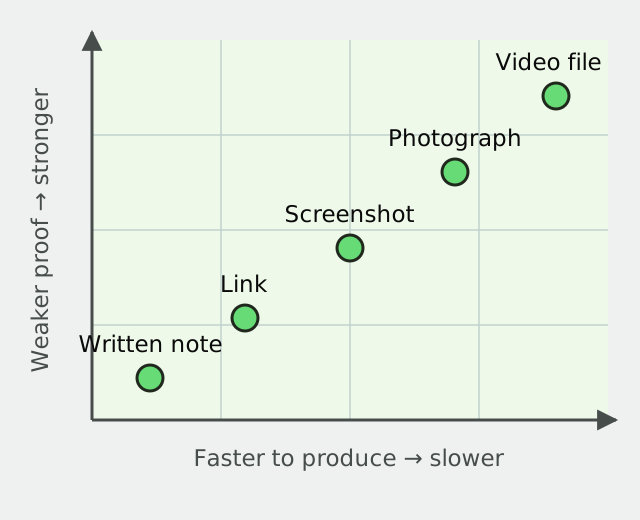
Proof is the other half of a submission, and the formats differ in how quickly each is produced.
Directly from brands. Smaller companies launching something frequently want testers and have no panel. A short message offering structured feedback in your category occasionally works, and pays better than any panel because there is no intermediary.
What a good testing report contains
Panels retain people whose feedback is usable, and most feedback is not. The difference is learnable in one session.
Report behaviour, not opinion
"I used it four times in the first week and twice in the second" is data. "I quite liked it" is not.
Say when you stopped, and why
Abandonment is the single most valuable thing a tester can report and the thing people most often leave out, because it feels like admitting failure. It is the opposite — a company paying for testing wants to know exactly where enthusiasm ran out.
Compare against what you were using before
Testers frequently review a product in isolation. The client already knows what it does; they want to know whether it beats the thing it has to displace.
Note the exact friction
The label you misread, the button you could not find, the page that loaded badly, the step where you stopped. Specific observations are what product teams can act on.
Answer every question asked before adding your own observations
Extra insight is welcome after the requirements are met, not instead of them.
Be willing to say it was not good
A panel of people who like everything is worthless, and the companies running them know it. Critical testers are the ones who get invited back.
The tax and admin nobody mentions
Two things catch people out, and both are simple once known.
Products received may be taxable
In many countries the market value of goods received in exchange for work counts as income, even where no cash changed hands. Whether it reaches a reportable threshold depends on volume and jurisdiction, and it is worth knowing rather than assuming.
Cash from panels is self-employment income
In most places that applies from the first payment rather than after a threshold. Keep a simple record: date, payer, amount.
Neither is a reason to avoid the work. Both are a reason to keep a spreadsheet from the first payment rather than reconstructing one in a year.
Getting more invitations
Volume is the constraint, so the useful moves are the ones that widen eligibility.
Join five panels rather than one. Each has different clients and different screening. The setup cost is an evening and it multiplies your invitation rate.
List every device you own, including old ones. Testing needs coverage of hardware people actually have, and a five-year-old phone is an asset here in a way it is almost nowhere else.
State your languages. Non-English testing is chronically short of people and pays better relative to difficulty.
Say which markets you know, not only where you live. Someone who lived somewhere for years is a legitimate fit for some regional work.
Keep responses fast for the first few studies. Early reliability determines how often you are contacted afterwards.
Why companies pay for this at all
Understanding the buyer makes you better at the work and better at spotting which offers are real.
A product that fails does so for reasons the team could not see from inside. They know how it is meant to be used, so they cannot notice that the instruction is ambiguous, that the packaging fights a wet hand, or that the second week is when people stop bothering. Every one of those is invisible to somebody who designed it and obvious to somebody encountering it cold.
That is what is being bought: a fresh pair of eyes, matched to the demographic the product is aimed at, reporting honestly. It explains the demographic screening, the detailed forms, and why panels prefer critical testers.
It also explains why the fake version exists.
A company that wants genuine feedback runs a panel. A company that wants a five-star average runs a review scheme and calls it testing, because the words are close enough to recruit people who did not check.
What it is realistically worth
Fifty to two hundred dollars a month for someone on several panels responding promptly. More if usability sessions come your way, because those pay several times what product panels do. Products rather than cash from manufacturer programmes, which is worth something only if they are things you would have bought.
That puts it in the same band as most casual task work, with the difference that it is more interesting and less predictable. As one strand alongside others it is worth having. As a plan on its own it is not, and the comparison of what home side hustles pay per hour sets out what the alternatives return for the same evening.