Mystery shopping is a real industry. Retailers, banks, restaurants and hotels pay research companies to send anonymous customers who record what actually happened, because internal reporting tells them what is supposed to happen.
It is also the home of one of the most persistent frauds online, and the reason is structural: in the legitimate version, a company you have never met sends you money. That makes the fake version unusually convincing. How the industry is structured and who pays for it covers the background if the model is unfamiliar.
What the work involves
You are assigned a location and a scenario. Visit at a stated time, behave like an ordinary customer, note specific things — how long until you were greeted, whether an upsell was offered, whether the toilets were clean, what the staff member said when you asked a scripted question. Then file a report within a deadline, usually the same day, with a receipt and often photographs.
The reports are longer than people expect. A fifteen-minute visit routinely produces forty minutes of form-filling, and the deadline is short because the client wants the observation while it is fresh.
Accuracy matters more than opinion. You are being paid to record what happened, not to judge it.
What it pays
| Assignment | Fee | Plus |
|---|---|---|
| Fast food, small retail | $8 – $15 | Reimbursed meal or purchase |
| Grocery, chain retail | $10 – $20 | Required purchase reimbursed |
| Restaurant, casual dining | $15 – $30 | Meal reimbursed to a cap |
| Bank or financial services | $25 – $60 | Usually no purchase |
| Car dealership | $40 – $100 | Longer visit, detailed report |
| Hotel or travel | $50 – $150 | Stay reimbursed, extensive report |
| Phone or online evaluation | $5 – $15 | No travel |
The fee is your payment. Reimbursement returns money you spent.
Those are two different things, and an assignment offering "up to $40" that turns out to be $35 reimbursement and a $5 fee pays you $5 for an hour of your time plus the drive.
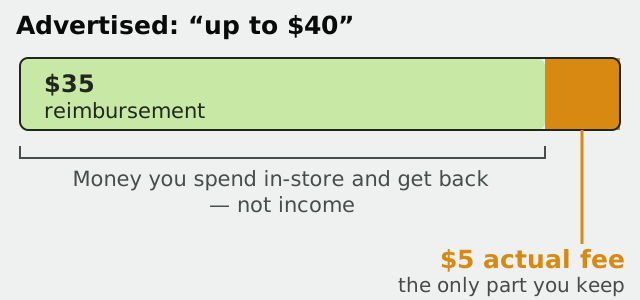
Read every listing for that split. It is the most common way people conclude mystery shopping pays badly, and they are right about the assignments they took.
The realistic income
$50 to $250 a month for someone actively applying in a reasonably populated area. More if you live somewhere with high assignment density and are willing to take the higher-paid financial and automotive work.
Two structural limits. Assignment volume depends on how many clients the companies have in your specific area, which you cannot influence. And most companies restrict how often the same shopper can visit the same location, because familiarity defeats the purpose.
The cheque scam, in detail
This is the one to know, because it is convincing and the loss is real.
You receive a message offering mystery shopping work, often after registering somewhere or posting in a forum. A cheque arrives, sometimes for a substantial amount — $1,500 to $4,000 is typical. Your instructions: deposit it, keep a few hundred as your fee, and use the rest to evaluate a money transfer service by wiring it to a named person.
Your bank makes the funds available within a few days, which feels like the cheque clearing. It has not cleared. Days or weeks later the cheque is identified as fraudulent, the deposit is reversed, and you owe the bank the entire amount. The wire transfer is gone and irreversible.
Variants use money orders, transfers into your account, gift card purchases, or cryptocurrency instead of a wire. The structure is identical — funds arrive, you forward a portion, the original reverses.
The other things to refuse
Any fee to register. Legitimate companies charge shoppers nothing. Ever.
Certification. Various bodies sell mystery shopper certifications. No company hiring requires one, and the certification is the product.
Paid lists of companies. The list of legitimate mystery shopping companies is publicly available from the industry's own trade associations, free.
Reimbursement-only assignments with a large required purchase. You are buying something with your own money for weeks before reimbursement, for no fee. Occasionally worth it if it is something you wanted; usually not.
Assignments requiring you to buy gift cards. A recurring fraud pattern regardless of how it is framed.
Anything arriving as an unsolicited direct message. Real companies post assignments to registered shoppers on their own platforms.
Getting accepted
The industry runs on scheduling, and schedulers reuse people who make their job easy.
Register with several companies
Assignments are distributed by whoever holds that client, so one registration sees a fraction of what exists in your area. Ten to fifteen registrations is normal for someone doing this seriously, and the setup is an evening each.
Complete profiles properly
Location, how far you will travel, availability by day, whether you have a car, demographics. Assignments are matched on these, and vague profiles match nothing.
Apply fast
Good assignments go within hours of posting. Many companies notify by email; some have apps. Speed matters more than experience.
File the first reports early and thoroughly
Your first three assignments determine what you are offered afterwards. A clean, on-time, complete report is worth more to a scheduler than any credential.
Take the unpopular ones initially
Awkward times, less convenient locations, longer forms. This is how new shoppers build the record that unlocks the better-paid work.
Never miss a deadline
A late report can invalidate the assignment entirely, because the client bought a same-day observation. Missing one is the fastest way off a scheduler's list.
Writing a report that gets you rebooked
Answer exactly what was asked, in order. Extra observations after the required fields, never instead of them.
Use times, not adjectives. "Waited four minutes before being greeted" beats "service was slow" every time. The client is comparing across hundreds of locations and adjectives do not aggregate.
Quote where quotes were requested. If the form asks what the employee said, write what they said rather than a summary.
Keep the receipt. Photographed clearly, with the time visible. A missing receipt invalidates most assignments regardless of report quality, which is the same logic behind proof standards on any task platform.
Stay neutral about people. You are evaluating a process, and a report reading as a complaint about an individual is less useful and often gets queried.
The costs that do not appear in the fee
Mystery shopping is the only work in this category with a travel cost, and ignoring it is how people conclude an assignment paid reasonably when it did not. Grouping assignments into one route is why this suits weekend work far better than a weeknight.
Fuel and mileage. An assignment eleven miles away costs real money to reach. Cluster assignments — three in one trip — or decline the isolated ones.
Unpaid travel time. Twenty-five minutes each way plus a fifteen-minute visit is over an hour for a fifteen-minute fee.
Money out before reimbursement. Required purchases are reimbursed after the report is approved, which can be several weeks. On grocery or restaurant assignments this is a real float, and doing several at once means a few hundred of your own money is outstanding.
Report time. Consistently longer than the visit. Budget forty minutes for a fifteen-minute assignment until you know a company's forms.
Run the arithmetic honestly on the first five assignments: fee, minus fuel, divided by travel plus visit plus report. That number is what the work pays, and it is usually half what the listing implied.
Assignments worth taking after that calculation tend to be the ones nobody else wants — awkward hours, less convenient sites, longer forms — because those carry a bonus and less competition.
How it compares to online task work
Mystery shopping and online task work are the same shape — a specified job, proof attached, payment on approval — with one difference that decides which suits you.
Mystery shopping
Requires you to be somewhere. That constrains it to assignments near you, and it is also what makes it worth more per task than most online work, because the eligible pool is everyone within driving distance rather than everyone with a laptop.
Online task work
No travel and no fuel cost, and correspondingly more competition. Plenty of it sits on a general general marketplace for small paid jobs rather than a specialist scheduler.
The two combine well: online work fills the evenings when nothing local is available, and local assignments pay better when they appear.
Whichever you take, the terms worth checking are the same — is the work funded before you start, is there a stated review window, and can a rejection be challenged by appeal. The full check for any task platform applies to both.
Reimbursement float, and how to manage it
The float is the part experienced shoppers manage and beginners get caught by.
On assignments with a required purchase, you spend your own money and get it back after the report is approved — commonly two to six weeks later, sometimes on the company's monthly payment cycle rather than per assignment. Take six grocery assignments in a fortnight and several hundred pounds of your money is outstanding.
Three habits keep that manageable. Stagger assignments with large required purchases rather than clustering them. Know each company's payment cycle before accepting, because the difference between weekly and monthly matters at volume. And keep a record of what is outstanding, since reimbursements occasionally get missed and the only person tracking it is you.
None of this is a reason to avoid the work. It is a reason not to scale up faster than your own cash flow allows, which is the specific mistake that turns a decent side income into a problem.
Starting sensibly
Register with five companies found through the industry trade association's own directory rather than through a search result. Complete every profile field. Take the first three assignments you are offered even if they are unglamorous, and file all three early.
Track fee separately from reimbursement from the first assignment, the way any sane payout arrangement separates the two, and include travel time and fuel in your own arithmetic. The number that matters is what you earned per hour of your life, not what appeared in your account.
If that number works where you live, it is a reasonable strand of income. If it does not — and in some areas it will not, because assignment density is genuinely low — you will know in three weeks rather than three months.