Market research pays people to talk about products, services and decisions. It is one of the better-paid things an ordinary person can do with ninety minutes, and it is bottlenecked entirely by qualification rather than by availability.
Most people who conclude it does not work applied to five studies, got screened out of all five, and stopped. The screening rejection rate is high by design, and there are things that change your odds considerably.
What each format pays
| Format | Length | Pay |
|---|---|---|
| Short unmoderated task | 10 – 20 min | $10 – $60 |
| Online survey, qualified | 15 – 30 min | $5 – $40 |
| Online focus group | 60 – 90 min | $75 – $250 |
| One-to-one interview | 45 – 60 min | $100 – $400 |
| Diary or longitudinal study | 1 – 3 weeks | $150 – $500 |
| In-person group | 90 – 120 min | $100 – $300 |
| Professional or B2B study | 45 – 60 min | $200 – $600 |
Short unmoderated tasks are the same shape as usability testing, booked in bulk. The bottom row is where the real money is and it is invisible to most people, because they do not think of their job as a qualification. Anyone working in healthcare, law, finance, IT purchasing, construction, logistics or any regulated field is a scarce research subject, and clients pay accordingly.
A specialist who registers with B2B panels and does one study a month earns more from research than most people earn from any casual online work.
Why screening rejects almost everyone
A study is commissioned with a specification: forty people, aged 25 to 44, who bought a particular category in the last three months, do not work in marketing or media, and are not in a competing product's household.
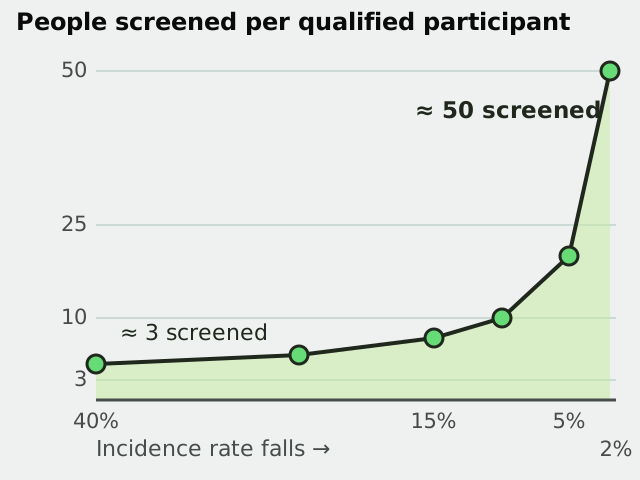
That specification excludes the vast majority of any panel. On a popular consumer study the screen-out rate can exceed nine in ten.
Being screened out means you did not match this study's quota, and nothing else.
Two consequences follow. Screening time is unpaid and it accumulates, which is the real cost of this work and the reason the effective hourly rate is lower than the headline. And volume matters more than quality of application — you cannot be more qualified for a study you do not fit, so the answer is more shots rather than better ones.
Qualifying without lying
There is a strong temptation to shade answers toward what the screener seems to want, and it is a bad trade.
Panels cross-reference. Your answers on this screener are compared against your profile and your previous screeners, and inconsistencies are flagged. Studies also include verification questions mid-session, and moderators notice when somebody claims to use a product they cannot describe. Being removed from a panel costs every future study, against a single $150 session.
What legitimately improves your odds is different from exaggeration.
Complete your profile fully and keep it current
Panels match on what they hold about you, so a profile listing your job, your household, the categories you buy and the devices you own is matched against far more studies than a sparse one. Update it when something changes, particularly a job change, which frequently opens B2B work.
Respond within the hour
Studies fill fast, and a screener answered next morning is usually too late regardless of fit.
Answer screeners carefully rather than quickly
Contradicting yourself between question four and question eleven is a common auto-rejection, and it happens when people rush.
Register with several panels
Each holds different clients, so one panel shows you a fraction of what is running. How panels are briefed and filled is set out in research participant recruitment.
What a session is actually like
The focus group
Six to ten people on a video call with a moderator, for sixty to ninety minutes. You will be asked to keep your camera on, to speak up, and occasionally to react to concepts shared on screen. The moderator's job is to stop two people dominating, so expect to be invited into the conversation directly.
The one-to-one interview
Easier for most people. One researcher, a conversation, no competing for airtime. These pay more and are the format worth pursuing if groups are uncomfortable.
A diary study asks for short entries over one to three weeks — a photograph, a note, a rating, usually daily. Pays well in total and the failure mode is forgetting, which forfeits the incentive on most studies.
What every format wants is specificity. "I liked it" is worthless to a researcher. "I stopped using it in the second week because the lid was awkward with wet hands" is exactly what the client bought. Participants who give concrete answers get invited back, and panels track that.
Being good at it
Panels keep records on participants, and being invited back is worth far more than any single session. What separates people who get regular invitations is fairly consistent.
Turn up, on time, with a working camera and a quiet room. Sessions are scheduled around a moderator and several other participants, and a no-show costs the recruiter their relationship with the client. One is usually enough to be dropped.
Talk. It sounds obvious and the most common moderator complaint is participants who answer in three words and wait. You were recruited because your opinion is the product; withholding it makes the session worthless and it is noticed.
Be specific rather than agreeable. Researchers are not looking for consensus, and a group where everybody agrees produces nothing a client can act on. Disagreeing with the person before you, politely and with a reason, is precisely what a good moderator is trying to elicit.
Say when you do not understand something. Confusion is data. Participants who nod through a concept they did not follow are the reason products launch with names nobody parses.
And do not perform. Exaggerated enthusiasm is transparent on camera and researchers discount it, which wastes the session for everyone.
The professional angle, in more detail
Worth expanding because it is the largest earning opportunity in this whole category and most people in a qualifying job never look.
Business-to-business research recruits people by their working role: a nurse who influences purchasing decisions, an IT manager who evaluates software, a solicitor, an engineer specifying materials, a pharmacist, a facilities manager, somebody who chooses a company's insurance. Clients want to understand how those decisions get made and there is no substitute for asking the people making them.
The recruiting pool for any given specification is tiny, which is why the rates are three to five times consumer research. A sixty-minute interview at $300 is ordinary in this segment, and specialist clinical or financial studies go higher. The same scarcity drives the market above it, where expert networks pay for one-hour consultations with people several years into a specific role.
Getting into it means registering with panels that specialise in B2B and professional recruitment rather than general consumer panels, and completing the professional fields properly — job title, sector, company size, whether you influence purchasing, what systems you use. Those fields are the entire matching mechanism and general panels often do not even ask.
Payment, and how it arrives
Usually within one to three weeks of the session, by transfer, digital gift card or occasionally cheque. Some panels hold a threshold before releasing funds, which is worth comparing against how payouts work elsewhere.
Two things to establish before your first session. What form the payment takes, because a study paying in points that convert badly is worth less than the number suggests. And what happens if a session is cancelled by the client, since good panels pay a portion for a cancellation inside 24 hours and many pay nothing.
Tax applies as it would to any self-employment income in most countries, from the first payment rather than after a threshold. Keep a simple record.
Spotting the fraudulent recruitment
The industry is legitimate and its recruitment channels attract fraud, because studies genuinely do send strangers money.
Where research sits against the alternatives
Compared with other ways of earning from an evening, research participation has an unusual shape: a high rate and low, unpredictable volume.
A single focus group at $150 for ninety minutes is a better hourly than almost anything else on offer without a qualification. Two of those in a month beats a great deal of steady task work. The problem is that you cannot decide to do two; you can only decide to be eligible and available when they appear.
That makes it a poor sole plan and an excellent supplement. The workable pattern is something with predictable availability filling the ordinary weeks, and research participation taken whenever it arrives, because the rate justifies rearranging an evening for it.
The one exception is professional participants. B2B research recruits often enough from a small enough pool that somebody in a qualifying role can treat it as a reliable monthly line rather than an occasional windfall.
Making it produce something regular
Register with five to eight panels, including at least two that specialise in your professional field if you have one. Complete every profile field on each.
Then treat screeners as a background activity rather than a task. Ten minutes a day answering whatever has arrived produces far more qualified sessions than an hour once a week, because timing matters more than effort.
The professional multiple holds because the B2B panels are competing for a small pool and know it.
For how that compares against other ways of spending the same evenings, the wider look at what home side work pays sets the options against each other, and the check for any platform applies to panels as much as anywhere.