Content moderation listings tend to read like data entry. A queue, a policy document, a decision, a target. That description is accurate about the mechanics and silent about the thing that actually decides whether somebody lasts six weeks or three years, which is what appears in the queue.
This covers both, in that order, and then the questions worth asking before accepting anything.
What the work is
A platform has rules. People post things. Somebody decides whether a given thing breaks the rules and what should happen to it.
Automated systems handle the obvious cases in enormous volume. What reaches a human is what the machine could not resolve, which means the human queue is selected for ambiguity by construction. That is a structural feature of the job worth understanding early: you are not seeing a representative sample of what gets posted, you are seeing the residue of what could not be decided automatically.
The ordinary majority
Spam, misapplied categories, borderline advertising, arguments that are unpleasant but permitted, copyright claims, misleading thumbnails. Repetitive, mildly tedious, entirely manageable. Most of the shift.
The difficult minority
Graphic violence, child safety material, self-harm, extremist content, coordinated harassment. A small proportion of the volume and effectively all of the cost. Which queue you are assigned determines how small.
The decision itself is usually not the hard part. The policy is written down, the categories are defined, and after a few weeks most calls are quick. What is hard is doing it several hundred times a shift while staying consistent, because consistency degrades with fatigue and consistency is what is measured.
The four tiers
Pay separates along the same lines it does in most of this market — by how many people are eligible.
| Tier | Hourly | What it needs |
|---|---|---|
| General queue, English | $12 – $22 | Judgment, reading comprehension |
| Non-English and regional queues | $16 – $30 | Native fluency, cultural context |
| Specialist categories | $22 – $45 | Domain training, often vetting |
| Escalation, policy and appeals | $25 – $60 | Experience, legal or policy knowledge |
Non-English work pays more for the reason it always does: a moderator for a language with few speakers online cannot be replaced quickly. Cultural context is a real part of it too, because whether something is a threat, a joke or a slur is frequently undecidable without knowing the setting.
A rule written in California and applied to a conversation in another language is only as good as the person holding both.
The escalation tier is the one worth aiming at. It handles the cases the general queue could not resolve, contributes to how policy is written, and involves fewer decisions of greater weight. It is also the only tier with a real career path attached.
The part the listing leaves out
There is substantial documented evidence that sustained exposure to disturbing material causes psychological harm, and the industry has been the subject of litigation and reporting on exactly this point for years. Treating it as a risk to manage rather than a rumour to dismiss is the correct starting position.
The conditions that matter are specific and askable.
Queue assignment
The single biggest factor. A general queue at a shopping platform and a child safety queue at a social network are not the same job in any meaningful sense.
Volume targets
A target high enough that you cannot pause after something difficult removes your only real coping mechanism during a shift.
Category opt-outs
Whether you can decline a category permanently, and whether declining affects your standing. If it costs you work, it is not an opt-out.
Support provision
Whether psychological support exists, whether it is a clinician or an employee assistance phone number, whether it is available during a shift or only afterwards, and whether using it is confidential.
Rotation
Whether anyone is moved off severe queues periodically as a matter of policy, or only on request after they are already struggling.
Remote work adds a factor that in-house work does not have. In an office there are other people who saw the same thing and a physical boundary between the queue and the rest of your life. Working from home, both are gone, and the queue is in the room where you sleep. People who do this sustainably from home tend to be deliberate about a hard stop, a separate space, and somebody they can talk to who understands the work.
A shift, in practice
Worth describing concretely, because the abstractions hide how the day actually feels.
The queue is a list. Each item is a piece of content, the reason it was flagged, and the applicable policy sections. You read, decide, select a category, sometimes write a short justification, and move on. Most take well under a minute.
Accuracy is audited by sampling your decisions against a reviewer or a set of pre-decided cases. That audit score, rather than throughput alone, determines standing at any employer worth working for — though both are tracked, and employers differ in which one they lean on when the two conflict.
The rhythm that people settle into is not steady. There are stretches of unremarkable content where the work is nearly automatic, punctuated unpredictably by something that stops you. The unpredictability is the tiring part rather than the volume, because you cannot brace for it and you cannot tell from the queue what is coming next.
Shifts are frequently fixed rather than flexible, particularly where coverage has to be continuous across time zones. That is a meaningful difference from most remote work and it catches people who came to this expecting to choose their hours.
Getting hired
The screening is unusual, and it is worth knowing what is actually being measured.
There is almost always a policy assessment: a set of edge cases against a supplied rulebook, where you decide and justify. The correct answer matters less than whether you applied the policy as written rather than your own view. Moderators who substitute personal judgment for policy are the expensive kind of hire, and the test is built to find them.
Then consistency. Some employers test the same case twice in different wording. Answering differently is the flag.
The job is applying somebody else's rules faithfully, including when you disagree with them. That is a specific skill and not everybody has it.
What is rarely required is a degree or prior moderation experience. What helps is fluency in a second language, familiarity with a specific platform's culture, or any professional background involving applying rules to messy real situations — nursing, teaching, claims handling, customer complaints.
What automation changed
Automated classification now handles most of the volume, and the effect on the human job is not what people assume.
The obvious cases left the queue first. What remains is what an automated system could not confidently classify, which means the ambiguous, the contextual, the newly invented, and the severe. Volume down, difficulty up, and severity concentrated.
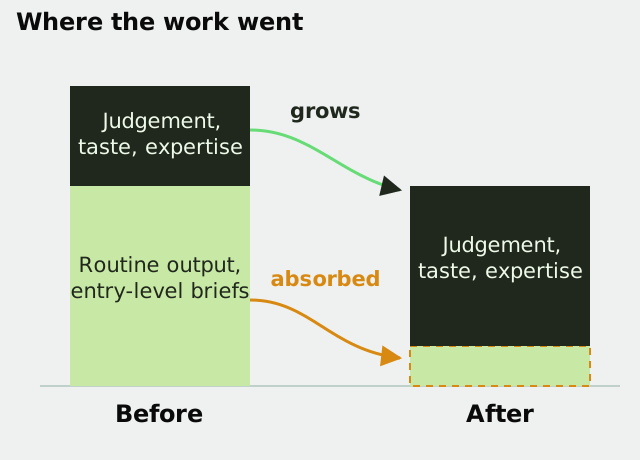
So the job is becoming more skilled and less numerous. Good for anyone in the specialist and escalation tiers, and the reason the general tier is a worse place to plan a long stay than it was five years ago.
It also means the human decisions carry more weight than they used to, since nobody is checking the automated ones at the same rate. That is a real professional responsibility and one of the more compelling arguments for the work.
Whether to take it
There is a version of this job that is genuinely good: a defined queue, a sane volume target, real support, a rotation policy, and a route into policy or escalation work. It pays reasonably, it is intellectually more interesting than most remote work at the same rate, and the people who do it well are doing something that matters.
There is another version, at the same advertised rate, with an unbounded queue, an unrealistic target, no opt-out and a support line nobody answers. The listing for both is written by the same recruiter and reads identically.
The difference is entirely discoverable in advance by asking the five questions above and paying attention to whether the answers are specific. An employer who has thought about this has concrete answers ready, because they have had to build the policies. One who has not will reassure you in general terms, and general reassurance is the finding.
For anyone weighing this against adjacent online work, paid app testing and research studies usually involve less exposure to harmful material and clearer one-off deliverables. These are contractor arrangements in most cases, and what that costs in protections and tax applies to each of them equally. For the view from the commissioning side, including the throughput targets that decide what this work feels like, how moderation is actually bought sets out the structures and their trade-offs.
If the appeal is flexible online work rather than moderation itself, compare it with content-creator tasks and product-testing jobs before accepting the safety trade-off.