"Content creator job" gets used for five arrangements that have almost nothing in common except the output. One is a salaried position. One is filming clips for brands who post them. One is building your own audience and monetising it.
Sorting which you are actually pursuing matters, because the entry requirements are completely different and only one of them needs a following.
The five routes
| Route | Typical pay | Audience needed | Time to first money |
|---|---|---|---|
| Employed social or content role | $38k – $70k salary | No | Normal hiring cycle |
| Agency or studio production | $25 – $60/hr | No | 2 – 8 weeks |
| Brand-commissioned production | $75 – $500 per piece | No | 4 – 8 weeks |
| Freelance production for hire | $40 – $150/hr | No | 4 – 12 weeks |
| Your own channel, monetised | Highly variable | Yes | 6 – 24 months |
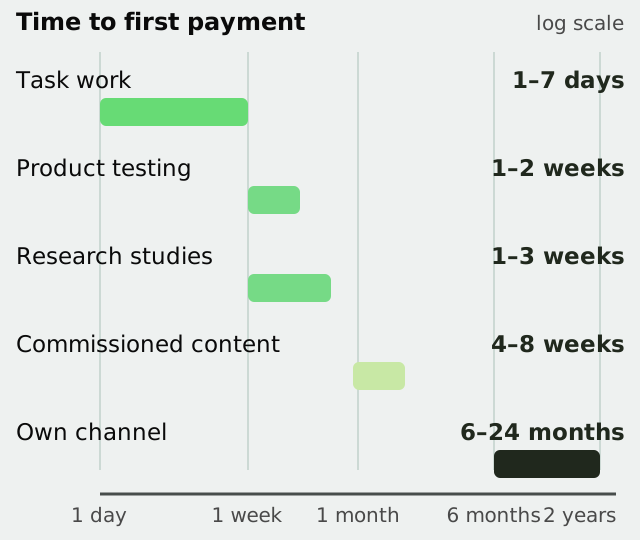
Four of the five buy your ability to produce something. Only the fifth buys your audience, and it is the slowest and least predictable of them.
That inversion catches most people out, because the fifth is the one the phrase evokes. The right-hand column is where it shows: the route with the highest ceiling is also the one that pays nothing for the longest.
Employed roles
Social media manager, content producer, video editor, community manager, content marketer. Ordinary jobs, advertised on careers pages and job boards, with salaries, contracts and holiday.
Screening is on portfolio plus evidence you understand distribution rather than only production. Companies hiring for these have been burned by people who can film beautifully and cannot say why a post underperformed.
Agency and studio work
Creative agencies, production studios and marketing shops subcontract content production constantly. Rates land fifteen to thirty percent below what the end client would pay directly, and in exchange you never prospect.
Getting on a roster takes longer than applying to a job because agencies rarely advertise; they collect people through referral and inbound. Emailing whoever commissions creators — usually a producer or creative strategist rather than anyone in business development — with a portfolio and your category is the approach that works.
Once on, the volume can be steady for years. Briefs are tighter and deadlines shorter, because the agency already promised the client a date.
Brand-commissioned production
Filming short videos that brands post on their own channels. No audience required, because they are buying the file rather than access to your following.
This is the fastest of the five to a first payment for somebody starting from nothing, and the barrier is lower than it looks: brands buying this specifically want footage that looks like a real person filmed it, so a phone and daylight exceed the technical requirement.
What they need first is four sample clips, which you make yourself with products you already own and label honestly as spec work. That takes a weekend. Then four to eight weeks of applying, which is the actual cost of the route and where most people stop.
The seven-day version of that setup covers what to film. What it pays once usage rights are priced properly covers why the same clip can be worth $75 or $400, and the wider brief market shows who is commissioning.
Audio is its own route with its own economics, covered in what voice work pays and how the market split.
Freelance production for hire
Filming, editing, photography, motion graphics sold as a service to whoever needs it — businesses, agencies, other creators. Highest hourly of the non-salaried routes, and the one requiring the most business capability alongside the craft.
Clients come from direct outreach and referral rather than platforms. The work is lumpy and the rate is good, which is the standard freelance trade.
Your own channel
The route everybody pictures, and the one that behaves least like a job.
Income arrives from platform revenue sharing, brand sponsorship, affiliate commission, memberships and product sales — usually several of those simultaneously, because no single one is reliable. Nothing pays for the first several months, and the distribution of outcomes is extreme: a small number of people earn a great deal and the median earns close to nothing.
None of that makes it a bad thing to build. It makes it a poor answer to "I need income by March", and it is worth being clear with yourself about which question you are answering.
The pragmatic pattern among people who do this successfully: build the channel slowly while earning from one of the other four routes, which also improves the channel because you are producing constantly for clients.
The portfolio, which four of five routes require
The same asset works for employed, agency, brand and freelance work, and it takes a weekend.
Four to six pieces
In one category. Depth reads as specialism; breadth reads as somebody trying things.
The format the work is delivered in
Vertical short-form if that is what you want to be paid for. Not a showreel with music — a cut-together highlight reel is a film-school habit that works against you here, because buyers want to see complete individual pieces they could run.
Hosted for a one-minute watch
A simple page with embedded video. Not a folder of links.
Labelled honestly
Spec work made with products you own is completely normal and every working creator started there. Implying a brand hired you when they did not is the one thing that reliably loses a booking.
Six lines of information
Your category, where you are and where you can film, whether you appear on camera, languages, turnaround you can commit to, and your rate.
Choosing between them
Want stability and a salary? Employed roles. Apply properly, and read responsibilities rather than titles.
The portfolio build in detail covers hosting and ordering, and the same page works for a brand ambassador application with barely any editing.
Want to produce without prospecting? Agency rosters. Slow to get on, steady once there.
Want money fastest from nothing? Brand-commissioned production. Portfolio this weekend, applications for two months.
Want the highest hourly and can handle sales? Freelance for hire.
Want to build something you own? Your own channel, funded by one of the others while it grows.
Most people who make a living at this end up doing two or three of them, and the combination is more stable than any single one — an algorithm change that halves channel income does not touch an agency roster or a brand client list.
Applying so it gets read
Whichever route, the people reviewing work the same way: they check whether you match the stated requirement, watch fifteen seconds of one piece, and decide.
Match the category. Send food work to food briefs. A portfolio spanning six categories asks the reviewer to imagine you in theirs, and most will not.
Lead with the closest sample, not your favourite. They watch the first one and frequently stop there.
Answer the stated requirements in the first line. Location, format, turnaround, whether you appear on camera. Reviewers filter on those before forming any opinion of the work.
Keep it to four sentences. Long applications correlate with people who did not know what to say.
Apply early. Most briefs fill from the first day's applicants.
Do not lead with rates for agency and employed routes. Rate discussions belong after they want you. For brand briefs where a rate is already stated, confirm you accept it and move on.
Rates, and raising them
The pattern is the same across the four paid routes: your first number sticks with any client who books you twice, so opening higher with new clients beats renegotiating with existing ones.
Three things justify more, and none of them is experience in years.
Usage rights, on anything a brand will run as advertising. A clip licensed for paid media is worth several times one licensed for an organic post, and the difference should be priced rather than assumed.
Variants. Three versions of one idea from a single setup costs you an extra half hour and gives a performance team something to test. Bundle it.
Turnaround. A guaranteed 48-hour delivery is worth a premium to anyone working to a launch, and costs you only the right to decline when booked.
Review your rate after every fifth booking. If every quote is accepted instantly, you are under-priced, and the occasional lost job is the cost of not leaving money on all the others.
Combining routes without burning out
Most people earning a living here run two or three of these simultaneously, and the combinations that work are not random.
Agency roster plus your own channel
The most common pairing. The roster pays the bills predictably, and the constant production makes the channel better than it would be otherwise. The risk is that client work always feels more urgent than your own, so the channel starves unless it gets protected time.
Brand-commissioned plus freelance for hire
Suits anyone comfortable selling. The same portfolio serves both, and the freelance work pays several times more per hour once a client exists. The brand briefs fill the gaps between projects.
Employed role plus occasional brand work is the lowest-risk version, and the one to check a contract about first.
What does not combine well is your own channel plus nothing else, early on. The income arrives late, unpredictably, and in a shape that makes planning impossible, which is why so many channels stop in month seven.
What everyone underestimates
Reliability outranks quality. Delivering on the day promised, in the format asked for, without argument on the first round of notes. Clients keep merely-good producers who are dependable and drop excellent ones who disappear.
Reading the brief. Most rejected work missed a stated requirement rather than being badly made.
The business half. Invoicing, chasing payment, scoping, and saying no. Nobody teaches it and it determines whether the craft is sustainable.
How much is not filming. Sourcing work, negotiating, admin, revisions. Budget for it when calculating whether a rate is good, because the effective hourly is always lower than the headline.
Where the relationship is ongoing rather than per-asset, what a brand ambassador actually does covers a route that pays on a different basis entirely.
For the term people most often search before finding any of this, what a digital creator is covers the six routes to being paid and which of them need an audience.