"UGC platform," "UGC creator platform" and "UGC creator marketplace" get used interchangeably, and between them they describe five different businesses. They have different cost structures, different failure modes, and different answers to the question of who is responsible when a clip is unusable.
Choosing the model first makes the rest straightforward. Comparing individual services across models is what produces spreadsheets nobody can act on. If you already know you want the task-platform route, how hiring creators works here covers the mechanics directly.
The five models
Managed agency. They write or refine the brief, source creators, manage delivery, handle revisions, and hand you finished assets. Cost is typically two to four times the creator rate. You are buying the management layer, and for a brand with no in-house capacity that is frequently the correct purchase. What that fee actually covers, function by function separates the parts worth paying for from the parts you may already have.
Curated roster. The platform vets creators and you select from a list, usually at rates the platform sets. Faster to a predictable result than an open pool, with the vetting priced in. Strong for standard categories, weak when your brief is unusual, because the roster was assembled for the standard case.
Open marketplace. Creators list themselves and you commission individually. Widest range, lowest floor on price, highest filtering burden. Quality varies enormously and judging it from a profile is genuinely hard.
Task platform. You publish one brief with a rate and a number of spots. Eligible creators reserve individual spots and submit against the same requirements. Lowest coordination cost at volume and no management layer at all. RentHuman is this model.
Creator network subscription. A monthly fee for access to a pool plus some volume of assets. Predictable cost, and worth checking carefully what counts as an asset and what happens to unused allocation.
Which one fits
| Your situation | Model that fits |
|---|---|
| No in-house capacity, need finished assets | Managed agency |
| Standard category, want predictable quality | Curated roster |
| One or two specific creators, unusual style | Open marketplace |
| Many assets, same brief, multiple markets | Task platform |
| Continuous monthly volume | Network subscription |
| Testing whether UGC works at all | Task platform, small |
Could a competent stranger execute your brief without asking you a question?
That is the honest test between the agency end and the task end. If yes, the management layer is a markup on something you already do. If no, pay for it — the alternative is thirty deliveries reflecting thirty interpretations of an ambiguous instruction.
Cost per usable asset, not cost per asset
Headline rates are the least useful comparison available, because the number of deliveries you cannot run varies far more between models than the fee does.
That last figure holds only if the brief was clear enough to produce that rate, which is the variable under your control rather than the platform's. What creators charge and why is the other half of the same arithmetic.
Two costs belong in that calculation and are usually omitted.
Review time. Twenty submissions against a checkable proof standard take about half an hour. Twenty against a vague brief take an afternoon plus a correction round. At volume this exceeds the fee difference between models.
Rework and delay. A correction cycle is a second review plus a schedule slip. Programmes running to a launch date pay for this twice.
What to check before committing
Six terms, in rough order of how often they cause problems.
Is the work funded before it starts
If a creator is filming against an intention to pay rather than committed money, the platform has moved the risk onto the person doing the work — and a supply pool that has been burned once is a pool that does not take your next brief.
How is a rejection handled
Who decides, on what timescale, and is there any route to challenge it. A platform where refusal is final and unexplained looks efficient to a buyer and quietly destroys the creator pool.
How many revisions are included
One correction with a deadline is reasonable and bounded. Unlimited revisions convert a fixed price into an open commitment for the creator, which they price in or decline.
Who sets the rate
A platform rate card removes a decision and removes control. Setting your own rate means you can pay up for scarce fits and down for simple asks.
What is the default usage licence
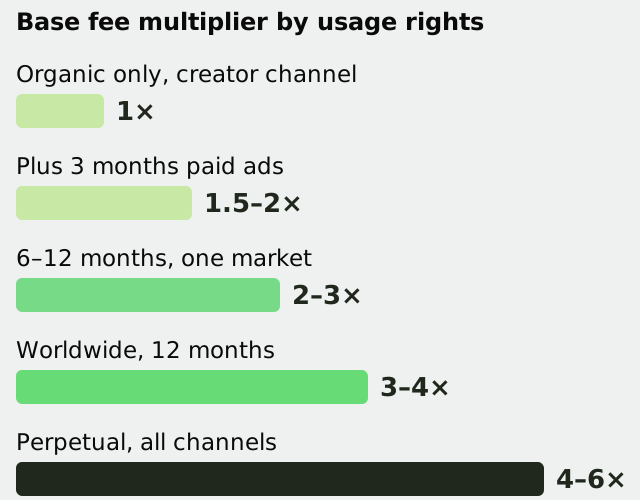
If the platform does not define one, your brief must. Clips filmed under an unstated licence produce disputes the moment ad spend goes behind them.
Is eligibility checked before or after delivery
Country, language and demographic requirements enforced at reservation prevent the failure where you discover at review that half the submissions came from the wrong market.
Reading a platform's pricing honestly
Every model presents its cost differently, and the presentation is designed to make comparison hard. Three translations worth making.
On RentHuman: campaigns are funded before they publish, the reward and required proof are visible before a creator reserves, eligibility is checked at reservation, posters get one correction request rather than unlimited revisions, unreviewed work approves automatically after 48 hours, and a rejection opens a 72-hour appeal decided by an administrator rather than by the poster who rejected it.
"Starting from $X per video." The floor, for the simplest possible deliverable with the narrowest licence. Find what your actual brief costs — scripted, with paid usage, in two markets — before treating that number as relevant.
"No platform fees." The money is somewhere. Usually a subscription, a spread between what the brand pays and what the creator receives, or paid visibility for creators that shows up as pressure on their rates. Ask what the creator receives from your payment; the gap is the fee whatever it is called.
"Included revisions." Check whether that means one round on one deliverable or unlimited on everything, and check what happens to the deadline during a revision. Generous-sounding revision terms often coexist with no cap on how long a review can take, which is the term creators actually price against.
The comparison that survives all of this: what does one asset I can actually run cost me, end to end, including my own review time. Run a fifteen-spot test on two models and you have that number for both, which is worth more than any amount of published pricing.
Questions worth asking a platform directly
Support teams generally answer these, and the answers separate models faster than any feature list.
- What proportion of submissions do buyers typically reject, and what happens to the creator's payment when they do?
- Is the creator paid if I never review the work?
- Can I restrict a brief by city, or only by country?
- What is the default usage licence if my brief does not specify one?
- Can I invite specific creators rather than opening the brief?
- If a campaign underfills, what happens to the unspent funding?
What none of them fix
Worth saying because platform-shopping is often displacement activity.
Rate determines supply on every model. A brief priced below what it asks for fills slowly or not at all, whether the platform curates, manages or lists.
Narrow targeting shrinks every pool. A brief restricted to one city in a small market has a small eligible population no matter whose logo is on the interface.
Running the same brief across two models
If the choice is genuinely unclear, the cheapest way to settle it is to run the same brief in two places and compare the number that matters.
Take fifteen spots on a task platform and three commissions on a curated roster or through an agency, using an identical brief. That is a small enough budget to be a test rather than a bet.
Then measure four things on each: how long it took to fill or to be assigned, how many deliveries met the brief without a correction, how much of your own time went into review and coordination, and the total spend divided by assets you would actually run.
The result is frequently not what the pricing pages implied. Managed routes often win on usable rate and lose badly on cost per asset. Task routes usually win on cost and lose when the brief left room for interpretation. Which of those matters more depends on your brief, and your brief is the thing no comparison table knows about.
Keep the result. A brand that has run this test once has a defensible answer to the model question for the next two years, and a brand that has not is choosing on marketing copy.
Where this platform sits, honestly
A good fit
Many assets against one brief, targeted by country, city or language, with proof attached to each submission and a fixed review process. RentHuman is the task-platform model.
A poor fit
If you want somebody to write the brief, curate a shortlist, or manage creators on your behalf. There is no management layer here and adding one is not on the roadmap, because the coordination cost it removes is the same cost that makes the model cheap.
If your campaign is one or two assets from a specific creator whose style you already know, an open marketplace serves you better. If it is a launch you cannot risk, an agency does. Saying so is more useful than pretending one model covers every brief.
A way to decide in an afternoon
Write the brief first, before looking at any platform. Include the opening two seconds, the exact length, the format, what must appear, what must not, and one example of good.
Then ask whether a stranger could execute it. If yes, take it to a task platform or a marketplace and run fifteen spots as a test. If no, either fix the brief or buy the management layer, and be honest with yourself about which.
Either way, run a small first round and measure cost per usable asset. That number, from your own campaign, settles the model question better than any comparison table including this one.