Most UGC campaigns that disappoint were lost at the brief. The creators delivered what was asked for, the footage was unusable, and the post-mortem blamed the talent pool.
A campaign that works is mechanical rather than creative: decide what you are testing, say precisely what a usable clip contains, fund enough spots to learn something, and review against a fixed standard rather than a mood. This is how to set that up. If you have not commissioned creator work before, how hiring creators works here covers the mechanics this page assumes.
Decide what the campaign is for
Three campaigns get called the same thing and they need different briefs.
Creative testing. You need variants to run against each other in paid social. The point is difference, not polish — five clips with genuinely different opening hooks tell you more than five well-made clips that all open the same way. Commission for variety and expect to kill most of them.
Volume for always-on. You need a steady supply of fresh footage because creative fatigues. Consistency matters more than range, and a retained group of creators beats a new campaign every month.
Proof at scale. You need many people demonstrating the same thing, often in different markets — first impressions, unboxings, a specific use case shown by people who plausibly represent the buyer. Here the count and the spread are the point.
Write down which one this is before writing anything else. Almost every confused brief is trying to be two of them at once.
How many clips
Fifteen to thirty on a first campaign.
Below fifteen there is not enough material to test, and a performance team running four variants learns very little about which direction works. Above thirty on a first run, you are paying to discover a brief problem at scale — if the requirements are ambiguous, you will get thirty ambiguous clips rather than five.
Run the small version, read what came back, fix the brief, then scale the same brief. The second campaign at eighty spots costs less per usable asset than the first at eighty would have.
What to pay
You set the rate. There is no platform rate card here, which means the number is a decision rather than a lookup.
Reasonable starting points for a straightforward short-form clip:
| Deliverable | Rate per creator |
|---|---|
| Simple first impression or unboxing | $40 – $80 |
| Standard short-form clip to brief | $80 – $150 |
| Scripted demonstration, multiple takes | $150 – $300 |
| Three hook variants from one creator | $200 – $400 |
The market floor is lower than the first row, and visibly so — briefs offering $15 for an unboxing exist and get taken. Budgeting there is a false economy: it selects for creators who have not yet priced their own time, and the failure shows up as reshoots, missed briefs and content you cannot use. What creators actually see across the market sets out the full range including the bottom of it, and what an agency adds on top of those numbers covers the route where somebody else writes the brief. For measuring whether the campaign moved anything once it runs, what a brand lift study can and cannot establish sets out the design and the arithmetic, and where the asset has to be a real customer speaking rather than a brief being executed, how testimonial video differs covers the consent and disclosure that come with it.
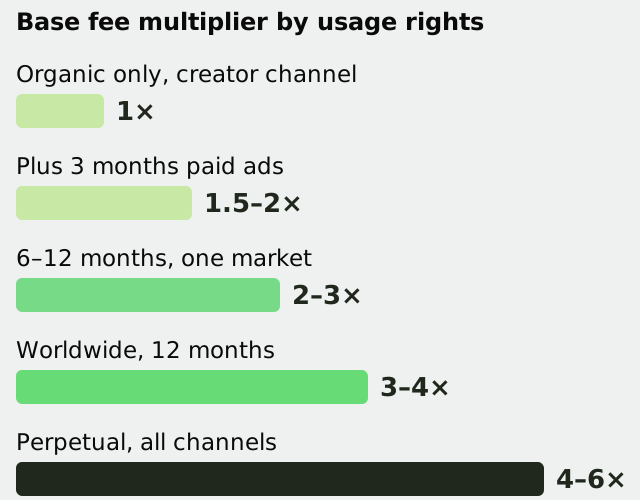
Two adjustments matter more than the base.
Usage. A clip you can only post organically is a different product from one you can put ad spend behind for twelve months across three markets. State the licence in the brief and price it. Creators who discover the licence after delivery either dispute it or decline the next campaign, and both are expensive.
Scarcity. Narrow geography, a specific language, an unusual demographic or a regulated category all shrink the eligible pool. Rates that clear easily in an open global brief will not fill a brief restricted to one city.
Underpricing does not save money. It fills slowly, attracts the least experienced applicants, and produces the revision cycle you were trying to avoid.
Writing the brief
Split it into the part everyone sees and the part that unlocks on reservation.
Public brief
Enough for a creator to decide whether they can do it and whether the rate is fair. The product category, the format, the length, whether they appear on camera, the countries eligible, the rate, the deadline, and the proof required.
Private instructions
Everything you would not want in a public listing. Campaign URLs, promo codes, unreleased product details, the exact script or talking points, and anything competitively sensitive. On RentHuman these stay hidden until a creator holds an active reservation on that specific spot.
Inside the brief, the things that actually determine whether footage is usable:
- The opening. Say what the first two seconds must contain. This is the single highest-leverage line in any UGC brief and most briefs omit it.
- Length, exactly. Not "short". A number, with a tolerance.
- Orientation and framing. Vertical, with headroom, because the platform crops.
- When the product must appear. Most viewers never reach second five.
- Audio. Whether they speak, whether you want ambient sound, whether you will add your own.
- What must not appear. Competitor products, other brands' logos, claims you cannot substantiate, music they do not own.
- Editing. Usually "none" — raw or lightly trimmed. Heavy edits make the clip read as an advert, which defeats the purchase.
- One example of good. A link to a clip in the style you want does more work than four paragraphs of description.
Targeting
Geography and language decide who can reserve, and getting this right prevents the most common waste.
Target worldwide when the setting does not matter and you want the campaign to fill fast. Target named countries when the accent, the setting, the retail context or the regulatory position is part of what you are buying. Target cities when the campaign genuinely depends on a place.
Targeting by country, city and language covers when restriction helps and when it just costs you fill rate. Add language requirements alongside geography rather than assuming them. A creator in Belgium may deliver in French, Dutch or English, and the brief should say which.
Eligibility is checked before a creator can reserve a spot, so a mis-targeted campaign does not surface as thirty unusable clips at review time.
Reviewing at volume
Reviewing twenty clips is a different job from reviewing one, and treating it as twenty individual creative judgements is how a campaign becomes a week of work.
Decide your rejection standard in advance
Write down what constitutes a fail before the first submission arrives — a missed requirement, unusable audio, wrong length. Deciding case by case produces inconsistency that creators experience as arbitrary, and it is the fastest way to lose the ones you want back.
Review against the brief, in order
Take the requirement list and check each delivery against it. Approve anything that meets the requirements even if you would have made a different creative choice. The variants you would not have chosen are frequently the ones that perform, which is the reason for commissioning variety.
Use the correction request sparingly and specifically
One correction, naming exactly what to change and why. Vague notes produce a second draft with the same problem.
Watch the clock
Unreviewed submissions approve automatically after 48 hours on RentHuman, which is deliberate — it means creators are never waiting indefinitely on a busy reviewer. Plan review time when you plan the campaign.
Why campaigns underfill, and what to do
A campaign that stalls at nine of twenty spots is the most common disappointment, and the cause is nearly always one of four things.
The rate is below what the brief asks for. A scripted demonstration requiring props and three takes will not fill at unboxing rates. Compare what you are asking for against what you are paying, honestly.
The geography is narrower than the supply. A brief restricted to one city in a small market may have a genuinely tiny eligible pool. Widening to the country, or splitting into two campaigns with different targeting, usually solves it.
The requirements are unusual without extra payment. A specific demographic, a particular room, a product creators must buy themselves, or an unusual filming setup. Each of those shrinks the pool and each should carry a premium.
The deadline is too tight. Creators plan filming around other commitments. A 24-hour turnaround at a standard rate filters out everyone with existing work, which is most of the people you want.
The fix is rarely to wait. Raise the rate, widen the targeting, or relax the requirement that is doing the filtering — then relaunch. A campaign sitting half-filled for a fortnight costs more in delay than the rate increase would have.
Getting creators to come back
The economics of the second campaign are much better than the first, and repeat creators are why.
Someone who has delivered for you once knows the brief style, the review standard and the turnaround expectations. Their second clip costs them less effort and costs you less review time, and the quality is usually higher because they know what you accepted last time.
Three things make creators want the next one. Review promptly rather than letting the clock run out. Give a specific reason when you request a correction, so it reads as a note rather than a rejection. And pay what you said you would pay, on the terms you stated, without renegotiating the licence after delivery.
None of that is generous. It is the difference between building a pool you can call on and starting from zero every quarter.
What we will not run
Worth stating plainly, because it changes what this platform is for.
That rules out some work. It also means a campaign run here can go through a brand's legal review, and that the payment rails underneath it are not sitting one complaint from termination. how campaigns are moderated before funding covers what is enforced and how.
Measuring whether it worked
Judge the campaign on the assets, not on the average.
Creative testing is a search for outliers. Twenty clips producing one that materially beats your current control is a successful campaign, even if the other nineteen never run. Averaging the batch and concluding the quality was mixed misreads what you commissioned — mixed is the expected shape of a test.
Three numbers worth recording each time:
Fill rate and time to fill. How many spots took, and how fast. This tells you whether your rate and targeting were right, independently of the footage.
Usable rate. Proportion meeting the brief well enough to run. Below about seventy percent, the brief was ambiguous rather than the creators being weak.
Cost per usable asset. Total spend divided by clips you would actually run. This is the only figure comparable across campaigns and across suppliers, and it is the one that shows whether the second campaign improved on the first.
Write those three down after every run. Two campaigns in, the pattern tells you what to change.
Running the first one
Pick one product, one format and two markets. Twenty spots. A rate you would be comfortable paying if you were doing the filming. A brief that names the opening two seconds and includes one example of good.
Fund it, let it fill, and read what comes back before deciding anything about the second campaign. Most of what you learn on a first run is about your own brief, and that lesson is cheap at twenty spots and expensive at a hundred.
Where the campaign is built around a track rather than a product, the mechanics change enough to be worth reading separately — how playlist and music promotion is bought covers what can and cannot be paid for.