The typical ambassador programme recruits several hundred people, ships each of them product, and generates a few dozen posts. The cost per usable piece of content ends up higher than simply commissioning the content would have been, and the programme is judged a success on headcount.
That outcome is predictable and avoidable. It comes from recruiting for enthusiasm rather than for output.
What you are actually buying
Three different things get bought under one name, and they have different economics.
Advocacy means people talking about you to their own networks, unprompted and continuously. Genuinely valuable, hard to manufacture, and what most programmes claim to want.
Content means assets you can actually use: clips, photographs, testimonials. Predictable, ownable, and better purchased directly than hoped for from volunteers.
Presence means people representing you at events and in retail. Hourly work, straightforwardly costed, and unrelated to the other two despite sharing a job title.
What an ambassador actually is covers the three from the ambassador's side, which is worth reading before designing anything.
Programmes fail most often when a brand wants the second thing and builds a structure for the first. Content is a deliverable and it responds to being paid for. Advocacy is a byproduct of people liking your product, and no programme design substitutes for that.
Why headcount is the wrong target
Recruiting is the easy part. Give away product and hundreds of people will sign up, which produces a satisfying number to report and very little else.
The reason is straightforward: signing up costs an ambassador nothing, and posting costs them effort. Without a reason to bear that effort, most will not, and the ones who do will taper within weeks.
A programme of twenty people who post regularly outperforms four hundred who signed up once, on every measure including cost.
Recruit against the output you need rather than against a headcount, and the design questions answer themselves.
Compensation, and what each buys
Product only is the cheapest and produces the least. It works where the product is genuinely desirable and the ask is minimal, and it produces nothing where either condition fails.
Product plus commission adds a reason to keep going, and only if the commission is real. Check the conversion path before designing around it: a code somebody must remember to type converts far worse than a tracked link, and a short attribution window on a product people research for a fortnight means your ambassadors earn nothing and quietly stop.
Paid per piece is where output becomes predictable. You specify the deliverable, the deadline and the licence, and you receive what you asked for. This is a content purchase rather than an ambassador programme, and being honest about that is usually the point at which programmes start working.
Hourly is the model for anything in person, and it is not optional. Event and field work is a job and pricing it as anything else does not fill shifts.
Disclosure, which is your problem
Ambassadors posting about you with any material connection must disclose it. Product, commission, payment and a meaningful discount all create one. Regulators pursue the brand where that fails, not usually the individual, so the programme has to handle it.
Three obligations follow. Tell ambassadors plainly and in writing that they must disclose, at recruitment and again in each brief. Monitor whether they actually do, because a programme that instructs and never checks is not a defence. And act when somebody does not, which means asking them to correct the post rather than quietly ignoring it.
Designing one that works
Size it to the relationships you can keep
Pick a number of ambassadors you can actually maintain a relationship with. If nobody on your team has time to speak to them individually, the number is too high.
Give them something specific to do, on a rhythm
"Post about us when you feel like it" produces nothing. A monthly prompt with a suggested angle, a hashtag and a link produces posts, because the effort of deciding what to say is the barrier rather than willingness.
Make the asset supply easy
Product shots, a few facts, the disclosure wording, and what not to claim. Long brand guidelines on an unpaid ask get discarded.
Recognise people publicly
For unpaid programmes this is a meaningful part of the compensation, and it costs nothing.
Set an exit
Ambassadors who stop posting should roll off rather than accumulating as an inactive list that flatters the headcount.
The same rules applied to product seeding covers the mechanics in more detail.
Then measure output per ambassador per month, and cost per usable asset. Those two numbers tell you within a quarter whether the programme is worth continuing, and most brands track neither.
Recruiting the right twenty
Who you recruit matters more than how the programme is structured, and the instinct to open applications works against you.
An open application form selects for people who want free product. Some of those are genuine advocates and most are collecting. The alternative is to go and find people who already post about your category unprompted, and invite them. That is slower, produces a fraction of the headcount, and produces most of the output.
Three signals worth checking before inviting somebody. Whether they have posted about your category in the last month, because dormant accounts stay dormant. Whether their audience is somewhere you actually sell, since a large following in the wrong market converts to nothing. And whether they post about everything they are sent, which tells you their audience has already learned to discount them.
Existing customers are the strongest source and the most overlooked. Somebody who bought the product twice, unprompted, has demonstrated the thing an application form only claims.
Running it without it becoming a job
The hidden cost of ambassador programmes is staff time, and it is what quietly kills them in month four.
Every ambassador is a relationship. Questions arrive, product needs shipping, posts need checking for disclosure, somebody goes quiet and needs a nudge. At four hundred people that is a full-time role nobody budgeted for, which is why so many programmes are announced enthusiastically and abandoned silently. The same line applies to music promotion, where what works and what gets you removed sets out the boundary.
Two things keep it manageable. Keep the number to what one person can maintain alongside other work, which is usually twenty to forty rather than hundreds. And batch everything — a monthly prompt to everyone at once, a monthly shipping run, a monthly check of recent posts — rather than handling each person as they surface.
If a programme cannot be run inside a few hours a month at your intended size, the size is wrong.
When to commission instead
If you need specific assets, on a deadline, that you own the rights to, an ambassador programme is the wrong instrument. It produces unpredictable output, on somebody else's channel, that you generally cannot use in advertising.
Commissioning directly solves all three. You write a brief, set a rate and a number of pieces, specify the licence, and receive what you specified. On RentHuman that means one brief with a reward per person and a number of spots, targeted by country, city or language, funded before it publishes, with proof attached to each submission and a fixed review process.
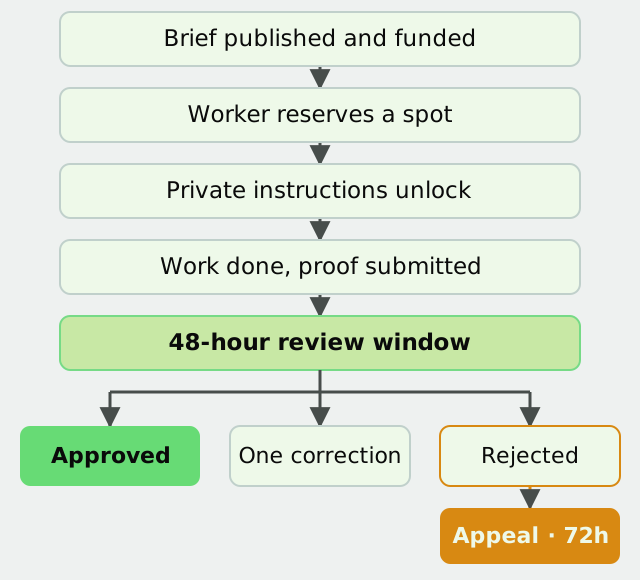
Commissioning creators directly sets out the brief side of that, and how a campaign is structured covers spots, proof and review.
The two are not competitors so much as different purchases. A sensible programme frequently runs both: commissioned content for the assets the marketing calendar depends on, and a small community for the advocacy that cannot be bought.
What we will not run
Campaigns requiring people to post as though unpaid, to omit a required disclosure, or to guarantee positive sentiment in exchange for product are rejected at moderation before funding.
That rules out a version of ambassador recruitment some agencies still sell, and it is the reason a campaign run here survives a legal review. the compliance position behind that sets out what is enforced.
Measuring it honestly
Two numbers, tracked monthly, tell you whether to continue.
Output per active ambassador
Not per recruited ambassador, which flatters. Count the people who produced something this month against the people you shipped to, and the ratio is usually sobering the first time.
Cost per usable asset
Total programme cost including product, shipping and staff time, divided by the pieces you would actually use. Compare that against what commissioning the same content would have cost. A meaningful share of programmes fail that comparison and continue anyway, because nobody ran it.
Two softer signals worth noticing. Whether ambassadors ask questions, since an engaged group generates conversation and a disengaged one goes silent. And whether anybody posts without a prompt, which is the only real evidence you bought advocacy rather than compliance.
If the programme fails on both numbers after two quarters, the honest options are to shrink it to the people who actually produce and pay them, or to stop and commission instead. Continuing at scale because the headcount looks good is the outcome this whole page exists to prevent.
A first version
Twenty people rather than two hundred, chosen because they already post about your category rather than because they applied. One clear monthly ask with a suggested angle. Disclosure wording supplied and checked. A small budget to pay the five who produce the most, which converts your best ambassadors into reliable content without converting the whole programme into a payroll.
Measure output per person and cost per usable asset after one quarter. Then decide whether to grow the community, grow the paid core, or stop — with the answer coming from your own numbers rather than from a benchmark.
Where the ask is a physical presence at events and activations rather than posts, what an experiential agency's invoice covers sets out how that work is normally bought and where the staffing layer goes wrong.