Upwork does one thing well: connect a client to a single freelancer for a contract of meaningful size, with time tracking, milestones and escrow around it. When the job matches that shape, it works.
Most people searching for an alternative have a job that does not match it. Sorting by mismatch rather than by feature list makes the choice obvious.
The four mismatches
The job is too small. A contract, a proposal round, an interview and a milestone structure is a lot of machinery for a forty-minute job. Below a few hundred dollars the overhead costs more than the work.
The job needs many people, not one. Everything about a freelance platform assumes selection: you review candidates and pick. If you need thirty people in four countries each doing the same twenty-minute task, there is nothing to select, and the model has no way to express it.
The filtering cost is too high. A posting can attract dozens of proposals within hours, most of them templated. Clients pay for that in reading time. Freelancers pay for it by competing against volume rather than against quality.
The work is specialist enough that open bidding is the wrong mechanism. For senior engineering, regulated finance work, or anything where a bad hire is expensive, sifting an open pool is a poor use of the risk budget.
For clients
Substantial contract, one person, general skills
If this is genuinely your case, the honest answer is that Upwork's competitors are structurally similar. PeoplePerHour, Freelancer.com and Guru all run proposals, contracts and escrow. Switching changes the population, not the model.
Better return usually comes from writing a tighter brief and inviting a shortlist rather than posting openly. Open postings are what generate the proposal flood people complain about.
Specialist or high-stakes
Vetted networks screen before anyone reaches you. Toptal for engineering and finance, various curated design and creative networks, and industry-specific talent collectives.
You see fewer candidates, pay more per hour, and spend almost no time filtering. That trade is good whenever the cost of a wrong hire exceeds the premium, which is most senior work.
One standard deliverable
A logo, a translation, a video edit, a set of product photographs. The gig format handles these efficiently because the deliverable is well understood and comparably priced. Which gig platform to use, and why switching often changes little covers that side.
Many people doing the same small thing
This is the case no freelance platform serves, and it is worth describing precisely because clients usually arrive at it sideways.
You need twenty-five people, each spending fifteen minutes: testing a signup flow on their own device, filming a short clip about a product, checking how a listing renders in their country, giving structured feedback on a design, verifying something locally. You do not want to interview twenty-five freelancers. You want one brief, executed twenty-five times, with proof attached to each.
That is a task marketplace. On RentHuman you publish one campaign with a reward per person and a number of spots, fund the whole thing up front, and eligible workers reserve individual spots. Targeting runs by country, city or language, and you specify what proof each person must submit — a link, a screenshot, a file, a written note, or a combination. Private instructions unlock only for a worker holding a reservation, so campaign details are not exposed in a public listing.
It does not replace Upwork. It covers the shape Upwork cannot express.
Ongoing part-time help
For freelancers
The reasons to look elsewhere are different, and so are the answers.
Proposal costs. Where submitting bids costs money, twenty unsuccessful proposals is a real expense against nothing. Platforms without that structure change the arithmetic, though they usually recover it another way — check where.
Competing on volume. If your proposals disappear into a pile of forty, the answer is rarely a different pile. It is specialising until you are one of three people who fit, which works on any platform.
Fees on earnings. Compare what you actually receive, not the headline percentage. A lower fee on a platform with fewer buyers is worse than a higher fee on one with work.
Client size drift. As platforms chase larger clients, the character of what gets posted changes. If the work you want has thinned out, that is a real signal and worth acting on rather than waiting out.
Direct clients. The consistent finding among freelancers earning well: platforms are useful for discovery and poor as a permanent home. A retained direct client at a few hours a month typically out-earns a great deal of platform activity, and the only cost is outreach.
Different work entirely. If what you sell is short-form content, structured feedback or small verifiable jobs, freelance platforms are the wrong venue. Those markets have thinner competition and better rates. What creator work pays once usage rights are priced properly is the clearest example.
Getting more from a shortlist than from an open posting
Whichever platform you land on, the mechanism you choose matters more than the brand, and clients underuse the one that works.
An open posting
Maximises reach and maximises noise. You will receive proposals from people who did not read the brief, because the marginal cost of sending one is near zero for them and the reading cost is entirely yours.
An invited shortlist
You search, pick six profiles that genuinely fit, and invite them. Response rates to direct invitations are high because the freelancer knows they are one of a few rather than one of forty, and the proposals you get back are written rather than pasted.
Three things make a shortlist work:
Search on evidence, not on rating. Portfolio pieces resembling your job beat a five-star average built on unrelated work.
Write the brief before you search. Deliverable, deadline, budget range, and how you will judge success. Freelancers filter on clarity, and the good ones decline vague briefs rather than bidding on them.
Say the budget. Withholding it wastes everyone's time and filters for people who guess low rather than people who fit.
This costs an hour of your time and removes most of the complaint that drives people to look for alternatives in the first place.
What to compare, since fees change
Any specific percentage in an article about this goes stale quickly. Check current numbers directly, and check these alongside them.
Total client cost and total freelancer receipt. Two numbers, compared across platforms. Everything else is presentation.
Whether funds are committed before work starts. Escrow or funded campaigns mean the worker is not extending credit. On small jobs this matters more than the fee.
Dispute handling. Who decides, on what timescale, and whether a rejection can be challenged at all. A platform where refusal is final and unexplained transfers the entire risk of an opinion onto the person who did the work.
Revision limits. One correction with a deadline is reasonable. Unbounded revisions convert a fixed price into an open commitment.
Whether the format fits the job. The most expensive mistake is picking on price and then finding the platform cannot express what you need.
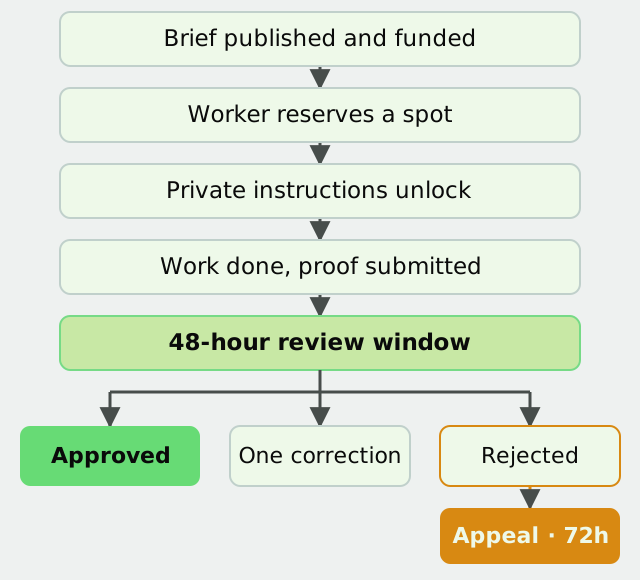
On RentHuman campaigns are funded before publishing, the reward and required proof are visible before a worker reserves, posters get one correction request rather than unlimited revisions, and a rejection opens a 72-hour appeal decided by an administrator rather than by the poster who rejected the work.
Leaving a platform without losing anything
Beyond that, a few things are worth doing in order, because the common failures are all avoidable.
Export what you can before you go quiet
Reviews, message history, contract records, anything documenting what you delivered. A dormant account can be restricted, and the record goes with it.
Keep your own client list from the start
Names, what they bought, what you charged, when. This is the only durable asset in freelancing and the only one no platform can take.
Do not close the old account immediately
Leave it running while the new channel proves itself. Cold starts take weeks, and having something producing income during that gap is what makes the move survivable.
Move one relationship at a time, where permitted
Wholesale migration announcements make clients nervous. A quiet transition at a natural contract boundary does not.
What a small job actually costs to run
Clients frequently underestimate this and it drives the wrong platform choice.
The cost of a job is not the rate. It is the rate plus the fee plus the time you spend writing the brief, filtering candidates, answering questions, reviewing the work, requesting a change, and reviewing again. On a $2,000 contract that overhead is noise. On a $30 job it is most of the total.
That is the whole argument for matching the platform to the job size. A proposal round for a forty-minute task means an hour of your time to buy fifteen minutes of somebody else's. Run that thirty times and the coordination is the project.
Two ways to cut it. Standardise the brief so the same text serves every instance, which only works if the platform lets one brief serve many workers. And define the proof precisely up front, so review is a check against a list rather than a judgement call, which is what makes review fast enough to do thirty times.
Decision path
One person, substantial contract, general skills — a general freelance platform. Invite a shortlist rather than posting openly.
One person, specialist or high-stakes — a vetted network. Pay the premium.
One standard deliverable — a gig platform, with a better brief than you were going to write.
Many people, the same small job, possibly country-specific — a task marketplace.
Steady ongoing hours — direct hire or an agency, not a marketplace.
Freelancing and unhappy — specialise, or move toward direct clients. The platform is usually not the binding constraint.
Run a trial before committing
Whichever direction you pick, put one small real job through it first.
Clients: post one genuine task, fund it, receive the work, complete the review. You find out how long each stage takes, whether the dispute route works, and whether the platform can express your brief — with almost nothing at stake.
Freelancers: complete one job and take the money all the way to your own account. The final step is the one that surprises people, because that is where withdrawal minimums, conversion spreads and verification requirements show up — what a payout route should state up front is the checklist to hold a platform to.
An afternoon of that beats discovering any of it during work that matters.
What switching does not solve
An unclear brief produces disappointing work on every platform, and the revision cycle that follows gets blamed on the freelancer.
Commodity skills are priced by how many people have them. No marketplace protects a rate that competition has set.
And every platform has the same cold start: no history, no reviews, applications into silence for the first few weeks. Moving resets that clock rather than skipping it. Before switching, it is worth asking honestly whether the problem is the platform or the position you occupy on it, because only one of those follows you.